
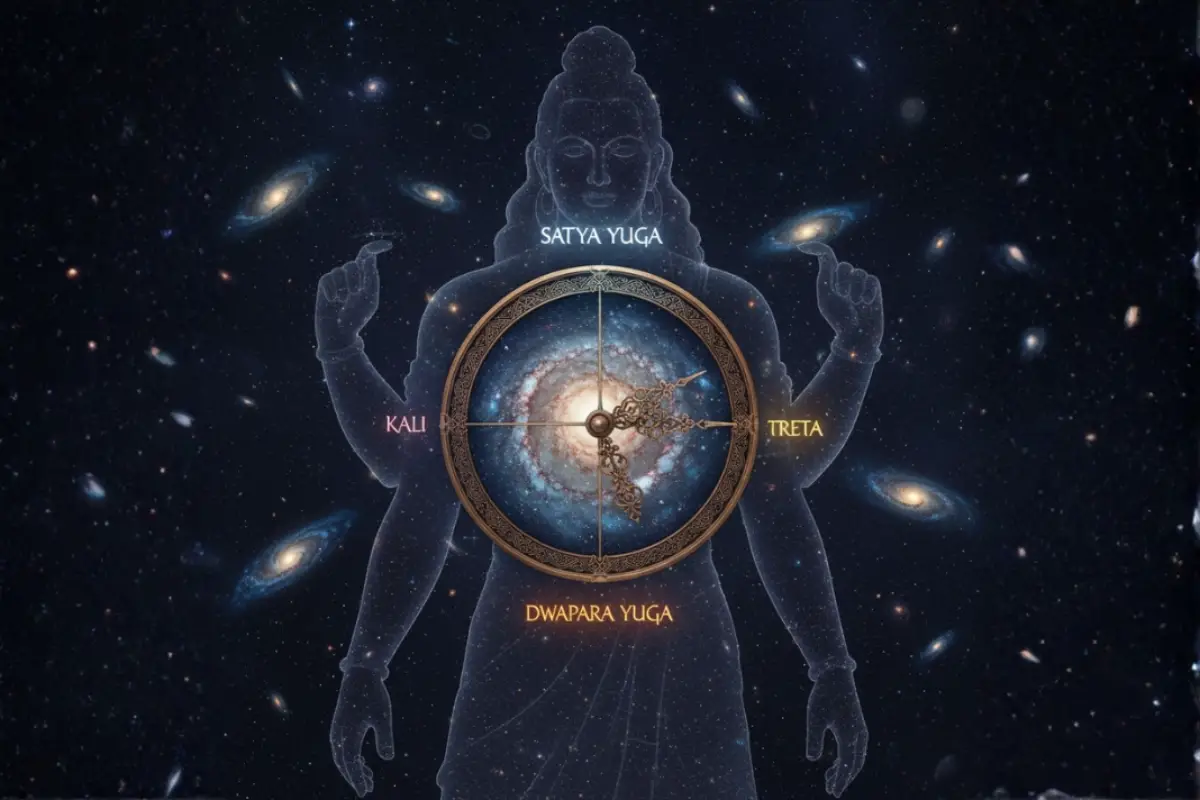

In the Western worldview, time is often seen as a linear arrow, moving in a straight line from a beginning (past) to an end (future). In Hindu cosmology, however, time is a vast, cyclical wheel—the Kaal Chakra, also known as The Time Wheel of Shiva. This foundational belief impacts the way Hindus see many things, drawing conclusions from observing the cycles of seasons, agriculture, planets, and stars. It is a grand, repeating pattern of creation, evolution, and dissolution with no absolute beginning or end.
This guide is your introduction to this profound concept—The Time Wheel of Shiva—where we will explore the cosmic ages known as the Yugas, the immense time cycles called Kalpas, and the final dissolution, Pralaya, all presided over by the ultimate master of time, Lord Shiva as Mahakal.
Cyclical vs. Linear Time: A Fundamental Difference
The Hindu concept of time is not a countdown to a final judgment, but an endless, rhythmic breathing in and out of the cosmos. Time in Hinduism is visualized as repeating cycles, meaning that the ages or the events of the universe go through endless patterns of creation and destruction. Just as seasons cycle and day follows night, the universe itself goes through immense cycles of manifestation and unmanifestation. Understanding this cyclical nature is the first step to comprehending the vast cosmic timescales described in the sacred texts. Time is seen as having both linear and cyclical elements, progressing as a spiral.
The Building Blocks: The Four Yugas (The World Ages)
The foundational cycle is a Mahayuga (Great Age or Chaturyuga), which is composed of four distinct Yugas (Ages). A Mahayuga lasts for 12,000 divine years or 4,320,000 human years. Each Yuga is progressively shorter than the preceding one, corresponding to a decline in the moral and physical state of humanity. Each Yuga has a different length and is characterized by a progressive decline in dharma (righteousness), wisdom, and human lifespan. Each Yuga is also preceded and succeeded by a transitional period known as Sandhya and Sandhyansa, respectively. These periods are 10% of the Yuga’s duration. The durations of the four Yugas follow a ratio of 4:3:2:1.
- Satya Yuga (The Golden Age): Also known as Krita Yuga, this first age lasts 1,728,000 human years (4,800 divine years). Dharma reigns supreme. Humanity is virtuous, wise, and deeply connected to the divine. The average human lifespan in Satya Yuga was around 100,000 years. People lived in perfect harmony with nature, and there was no war or conflict.
- Treta Yuga (The Silver Age): This second age lasts 1,296,000 human years (3,600 divine years). Dharma declines by one-fourth, meaning there is three-quarters virtue and one-quarter sin. The first signs of vice and conflict appear. The average human lifespan in Treta Yuga was around 10,000 years.
- Dvapara Yuga (The Bronze Age): This age lasts 864,000 human years (2,400 divine years). Dharma is at 50%, meaning virtue and vice are in equal measure. The average human lifespan in Dvapara Yuga was around 1,000 years.
- Kali Yuga (The Iron Age): This is the current age, lasting 432,000 human years (1,200 divine years). According to Puranic sources, Kali Yuga began in 3102 BCE, specifically at midnight on 17/18 February 3102 BCE, which also marks the departure of Lord Krishna from Earth. As of 2025 CE, over 5,126 years have passed, with approximately 426,874 years left. Dharma is at its lowest, only one-fourth remaining. It is an age of conflict, ignorance, and materialism, where the average human lifespan will be around 100 years and will decrease gradually. Near the end of Kali Yuga, when virtues are at their worst, a cataclysm and a re-establishment of dharma occur to usher in the next cycle’s Krita (Satya) Yuga, prophesied to occur by Kalki, the tenth and final incarnation of Vishnu.
The Larger Cycles: The Day and Night of Brahma
The Yuga cycle is just one small part of a much grander timescale.
- The Kalpa (A Day of Brahma): A full cycle of 1,000 Mahayugas (or 4.32 billion human years) constitutes one Kalpa, which is a single “Day of Brahma,” the creator god. During this “day,” life flourishes in the universe. A Kalpa is further divided into 14 Manvantara periods, each lasting 71 Yuga Cycles (306,720,000 years). Before the first manvantara and after each one are transitional periods known as sandhyas, each as long as a Satya Yuga—1.728 million years. The definition of a kalpa equaling 4.32 billion years is found in the Puranas—specifically Vishnu Purana and Bhagavata Purana.
- The Pralaya (A Night of Brahma): At the end of a Kalpa, a partial dissolution or Pralaya occurs. This period is like a “Night of Brahma,” a period of partial dissolution lasting an equal 4.32 billion years. During this Pralaya, the universe is not completely destroyed, but the earthly and lower heavenly realms are consumed by fire and water. Brahma then “sleeps” for a “Night” of equal length before a new day of creation begins. Pralaya, or dissolution, represents the cosmic reset, marking the end of a cycle and the prelude to renewal. The devastation of Pralaya is described in the Srimad Bhagavatam, where fire emanates from Vishnu’s serpent Adiseshan.
Mahakal: The Lord Who Exists Beyond All Cycles of Time
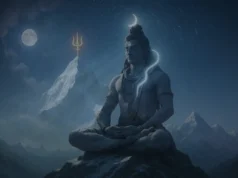
While Brahma’s life governs the cycles of Kalpas, even he is a created being. The ultimate reality that exists beyond all these vast cycles of time is Lord Shiva in his form as Mahakal (The Great Time). The word “Mahakala” comes from “Maha” meaning “great” and “Kala” meaning “time” or “death”. As Mahakal, Shiva is the supreme controller of time, beyond its limitations, and is often invoked as the destroyer of ignorance and the remover of obstacles related to the cycles of time and change.
This form signifies Shiva’s power over creation, preservation, and destruction, embodying the ultimate reality that transcends time itself. He is the ultimate source and the final destination of the entire Time Wheel. At the end of Brahma’s complete lifespan (100 divine years, equivalent to 311.04 trillion human years), a Maha-Pralaya (Great Dissolution) occurs. Maha-Pralaya represents the ultimate cosmic reset, where all physical and metaphysical realms are absorbed back into the cosmic waters or the Supreme Reality, and the entire cosmos, including all gods, dissolves back into the unmanifested form of Mahakal.
This process is believed to continue indefinitely, illustrating the eternal and timeless nature of the cosmos within Hindu philosophical perspectives. Shiva is also called Mahakala as he is the one who determines the end of Yama (the god of time/death), as evidenced in the Markandeya story where Shiva kills Yama.
The Hindu concept of time, a vast and cyclical Kaal Chakra—often described as The Time Wheel of Shiva—presided over by Lord Shiva as Mahakal, offers a profound alternative to linear understandings of existence. From the progressive decline of dharma across the four Yugas to the immense cosmic breath of Brahma’s Kalpas and Pralayas, this intricate framework reveals a universe in perpetual motion, an endless cycle of creation, preservation, and dissolution.
Understanding The Time Wheel of Shiva and these cosmic rhythms is not merely an academic exercise; it is an invitation to perceive the timeless nature of reality and our place within the grand, eternal dance of existence. Insights from ancient Hindu cosmology and astronomical time calculations found in the Vedic and Puranic texts preserved by the Archaeological Survey of India illustrate how deeply these ideas shaped early Indian thought. Shiva, as the ultimate master of time, reminds us that beyond all transient cycles lies an unchanging, formless consciousness that is the source and destination of all.
Frequently Asked Questions on Hindu Cosmology
1: How long does a full Yuga cycle (Mahayuga) last?
A Mahayuga, which includes all four Yugas (Satya, Treta, Dvapara, and Kali), lasts for a total of 4,320,000 human years. This is equivalent to 12,000 divine years.
2: Which Yuga are we currently in?
According to the Puranic scriptures, we are currently in the Kali Yuga, the “Age of Quarrel” or the “Iron Age”. It is the last of the four ages in the current Mahayuga cycle, and is believed to have started in 3102 BCE.
3: What is the difference between a Kalpa and a Pralaya?
A Kalpa is a period of creation, specifically a “Day of Brahma,” which lasts for 4.32 billion human years. A Pralaya is a period of dissolution or rest. The Pralaya that follows a Kalpa is like a “Night of Brahma,” a period of partial dissolution lasting an equal 4.32 billion human years.
4: Is the end of the Kali Yuga the end of the world?
No, in Hindu cosmology, there is no final “end of the world” in a linear sense. The end of the Kali Yuga is simply the end of the current, dark phase of the cycle. It will be followed by a period of transition and the dawn of a new, pristine Satya Yuga (Golden Age), beginning the entire Yuga cycle anew.
5: What is the role of Shiva in these time cycles?
While Brahma is the creator within a Kalpa, Shiva’s role as Mahakal (The Great Time) is ultimate. He is the timeless and formless reality that exists beyond all cycles. At the end of the universe’s complete lifespan (the Maha-Pralaya), all of creation, including all gods and all physical and metaphysical realms, dissolves back into him. As described in detailed philosophical research on Shaivism and cosmic dissolution by Stanford University, he represents the principle that transcends both creation and destruction. He is the ultimate source and the final destination of the entire Time Wheel.
To explore the profound significance of Shiva’s divine abodes, delve into our guide on The Ultimate Guide to Shiva Mantras.
For the latest updates on Ancient History, cultural insights, spiritual journeys, and other global events, visit mahakaltimes.com first.