
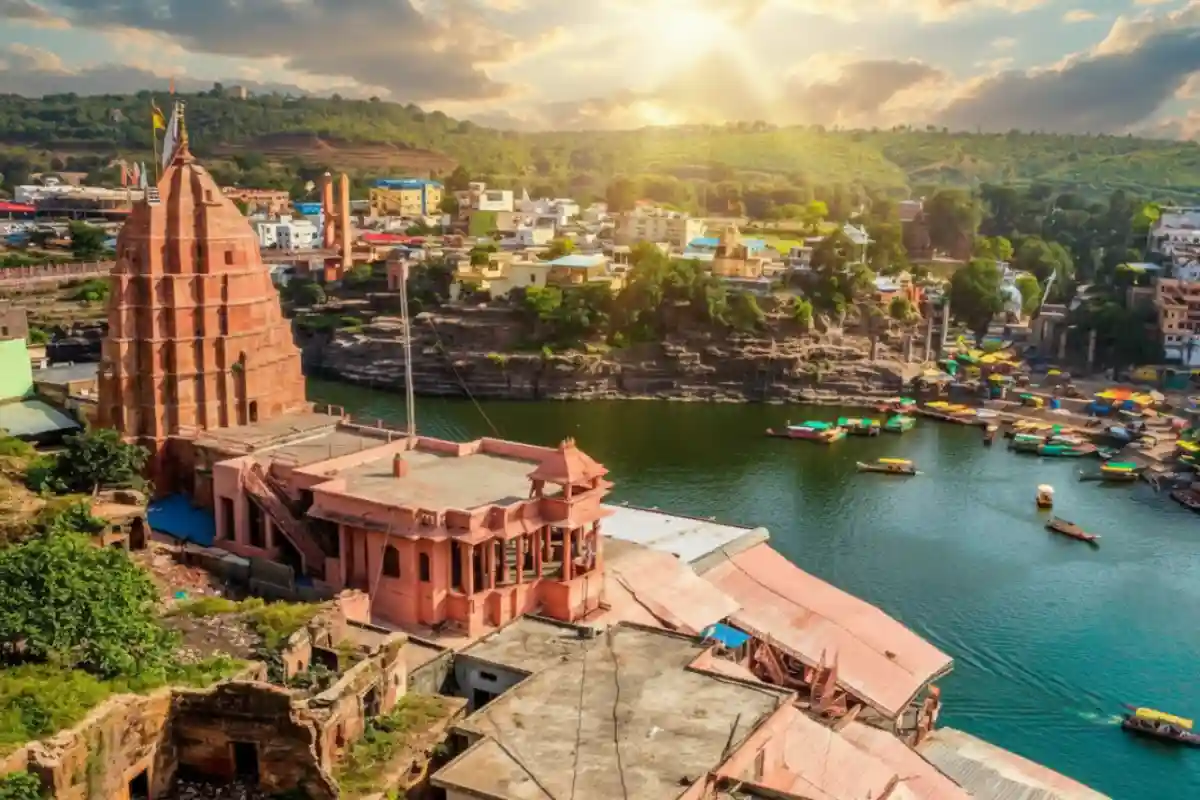

Omkareshwar Jyotirlinga, also known as the Omkareshwar Temple, is a sacred Hindu temple dedicated to Lord Shiva, located in Mandhata, near Khandwa city in the Khandwa district of the Indian state of Madhya Pradesh. It is one of the 12 revered Jyotirlinga shrines of Shiva. Situated on an island called Mandhata, near Khandwa city in the Narmada River, its shape is said to resemble the Devanagari ॐ symbol.
This unique sacred geography, combined with a rich tapestry of legends and historical resilience, makes Omkareshwar Jyotirlinga a profound pilgrimage destination. There are two main temples of Shiva here: Omkareshwar, located on the island, and Mamleshwar (Amaleshwar), situated on the southern bank of the Narmada River on the mainland.
The Sacred Geography: Mandhata Island and the Narmada River
Location Details:
Omkareshwar Temple is located in Mandhata city, also known as Omkareshwar, in Khandwa district of Madhya Pradesh state, India. It is situated on Mandhata or Shivpuri island, on the banks of the Narmada and Kaveri rivers (Kaveri being a tributary of Narmada). The island is approximately 4 km long and covers an area of 2.6 km².
The ‘Om’ Shape of the Island:
The shape of Mandhata island is said to resemble the Devanagari ॐ (Om) symbol, lending immense spiritual significance to the place. This iconic shape is deeply connected to the temple’s name, Omkareshwar, which means “Lord of Omkara” or “Lord of the Om sound.”
Importance of the Narmada River:
The Narmada River, which forms Omkareshwar, is one of the most sacred rivers in India. It is also notable for being home to one of the world’s largest solar power plants. Omkareshwar Jyotirlinga is uniquely situated on the northern bank of the Narmada River.
Comparison with Mahakaleshwar Jyotirlinga:
Madhya Pradesh is home to two Jyotirlingas: Omkareshwar and Mahakaleshwar Jyotirlinga. Mahakaleshwar Jyotirlinga is situated about 140 km north of Omkareshwar Jyotirlinga.
The Two Divine Forms: Omkareshwar and Mamleshwar
Omkareshwar is distinguished by two prominent Shiva temples, often considered equally sacred.
Omkareshwar: Lord of the Om Sound:
This temple, whose name means “Lord of Omkara or the Lord of the Om sound,” is located on the Mandhata island.
Mamleshwar (Amaleshwar): Immortal Lord:
The Mamleshwar temple, whose name means “Immortal Lord” or “lord of the Immortals or Devas,” is located on the southern bank of the Narmada River on the mainland. It is also known as Amareshwar. According to religious beliefs, a darshan (holy viewing) of the Omkareshwar Jyotirlinga is considered complete only when devotees also visit Mamleshwar.
Philosophical Connection: Advaita Matt on Omkaar:
Advait Matt philosophy states that Omkaar is composed of two words: Om (sound) and Akaar (srishti). Both are considered one, not two, reflecting the Advaita principle of “not two.” Om, as the beej mantra of Srishti (creation), is itself the creator of Srishti.
Shrine for Parvati and Ganapati:
Within the Omkareshwar Temple, there is a shrine for Parvati and Ganapati. The jyotirlinga within the Omkareshwar Temple is described as a “roundish black stone” representing the form of Shiva, and near it is a white stone representing Shiva’s consort, Parvati.
Legends of Omkareshwar: Divine Manifestations
The origin of Omkareshwar Jyotirlinga is woven into several ancient Hindu legends.
Legend 1: Brahma-Vishnu Supremacy Debate:
According to the Shiva Purana, Brahma and Vishnu once had an argument about the supremacy of creation. To test them, Shiva pierced the three worlds as an endless pillar of light, the jyotirlinga. Vishnu and Brahma split their ways, downwards and upwards respectively, to find the end of the light. Brahma lied that he had discovered the end, while Vishnu conceded his defeat. Shiva then appeared as a second pillar of light and cursed Brahma that he would have no place in ceremonies, while Vishnu would be worshipped until the end of eternity. The jyotirlinga shrines are believed to be those places where Shiva appeared as such a fiery column of light.
Legend 2: Vindhya’s Penance:
As per a Hindu legend, Vindhya, the deity controlling the Vindhyachal mountain range, was worshipping Shiva to propitiate himself from sins committed. He created a sacred geometrical diagram and a Lingam made of sand and clay. Shiva was pleased with the worship and is believed to have appeared in two forms, namely Omkareshwar and Amaleswara. Since the mud mound appeared in the form of Om, the island came to be known as Omkareshwar. Vindhya had desired to be greater than Mount Meru, and after Shiva granted his wish, he began to grow, obstructing the sun and moon. The gods then approached Sage Agastya, who asked Vindhya to stop growing until he returned, which he never did.
Legend 3: King Mandhata’s Devotion:
Another story relates to King Mandhata of the Ikshvaku clan (an ancestor of Rama). He worshipped Shiva here until the Lord manifested himself as a Jyotirlinga. Some scholars also narrate the story about Mandhata’s sons—Ambarish and Muchukunda—who had practiced severe penance and austerities here and pleased Shiva. Because of this, the mountain is named Mandhata.
Legend 4: Devas vs. Danavas War:
A third story from Hindu scriptures reveals that there was a great war between the Devas (gods) and Danavas (demons), in which the Danavas won. This was a major setback for the Devas, and hence they prayed to Shiva. Pleased with their prayer, Shiva emerged in the form of Omkareshwar Jyotirlinga and defeated the Danavas.
Historical Journey of the Temple
The Omkareshwar Temple has witnessed centuries of construction, destruction, and revival.
Construction by Paramara Kings (11th Century CE):
The temple is said to have been built by the Paramara Kings of Malwa in the 11th century CE. The earliest Paramara record at Mandhata dates to 1055-1070 CE, belonging to Paramara king Jayasimha I.
Chauhan Rulers’ Administration:
After the Paramara kings, the administration of the temple was taken over by the Chauhan rulers.
Destruction and Loot by Muslim Invaders (13th Century):
In the 13th century CE, the temple suffered destruction and loot by Muslim invaders starting with Mahmud Ghazni. Nevertheless, the temple remained intact without complete destruction.
Under Mughal Rule:
The temple stayed under the Chauhan Kings during the entire Mughal rule, without much renovation.
Rebuilding by Holkar Rulers (18th Century):
In the 18th century, the temple was rebuilt by the Holkar rulers. The construction was started by the first Holkar Queen, Gautama Bai Holkar, and later completed by her daughter-in-law Devi Ahilyabai Holkar. The region saw an expansion of Maratha power, and the holy city eventually entered its golden age under Queen Ahilya Bai.
Under British Rule and Post-Independence:
The temple came under British rule during the colonial era. After India gained Independence in 1947, the Archaeological Survey of India (ASI) took over the responsibility of the temple with the help of the Khandwa administration. The ASI is an Indian government agency responsible for archaeological research and the conservation and preservation of cultural historical monuments.
The Significance of Adi Shankara’s Cave
Location of the Cave:
Adi Shankara’s Cave, also known as Sri Govinda Bhagavatpada Cave, is an ancient cave located just below the Omkareshwar Jyotirlinga temple. It is situated on Mandhata or Shivapuri island on the Narmada River.
Adi Shankara Meeting his Guru Govinda Bhagavatpada:
This is believed to be the sacred place where the great saint Sri Adi Shankaracharya met his Guru Govinda Bhagavatpada. Adi Shankara is said to have studied the Govinda Bhagavatpada Granth and absorbed its lessons here. Legend states that Govinda Bhagavatpada returned from Badrinath to this cave hoping to meet Adi Shankara.
Image of Adi Shankara Installed:
An image of Adi Shankara has been installed in the cave, which can be found even today. The cave has a main hall and a small sanctum with a Shivalingam.
Saving the Town from Flood:
According to legend, Shankaracharya saved the town from a major flood by forcing the river water into his kamandalu (small bowl), which he had placed near the mouth of the cave, thereby saving his Guru who was in Samadhi.
Planning Your Pilgrimage
Nearest Airport:
Indore (Devi Ahilyabai Holkar Airport) is the nearest airport to Omkareshwar Temple. It is approximately 77 km from Omkareshwar.
Nearest Railway Stations:
The nearest major railway station is Indore (77 km). The nearest railhead is Omkareshwar Road Railway Station (Mortakka), which is 12 km away, but it is a narrow-gauge railway station and not on the mainline. Khandwa Junction is another nearby railway station.
Island Access:
Mandhata island, where the Omkareshwar temple is situated, can be approached by boats and a bridge.
Omkareshwar Jyotirlinga, with its awe-inspiring location on an ‘Om’-shaped island in the sacred Narmada River, stands as a profound testament to ancient faith and enduring spiritual power. Its rich tapestry of legends, from the divine debates of Brahma and Vishnu to the fervent penance of King Mandhata and the Vindhya mountain, underscores its significance as a site of divine manifestation and cosmic importance. Despite facing historical destruction, the temple’s resilience, its unique dual manifestation as Omkareshwar and Mamleshwar, and its association with Adi Shankara’s spiritual journey continue to draw countless devotees. As one of the two Jyotirlingas in Madhya Pradesh, Omkareshwar offers a deeply immersive pilgrimage, inviting all seekers to experience the timeless essence of Lord Shiva while appreciating the ancient temple architecture recognized in UNESCO’s list of World Heritage Sites.
Frequently Asked Questions
1: What is the significance of the island’s ‘Om’ shape?
The Mandhata island, on which the Omkareshwar temple is located, is said to be shaped like the Devanagari ॐ (Om) symbol. This unique natural formation is considered highly sacred and gives the temple its name, Omkareshwar, meaning “Lord of Omkara” or “Lord of the Om sound.”
2: What are the two main temples at Omkareshwar?
There are two main temples of Shiva at Omkareshwar. One is Omkareshwar, located on the Mandhata island, and the other is Mamleshwar (also known as Amaleshwar or Amareshwar), situated on the southern bank of the Narmada River on the mainland. Both are considered equally sacred and form part of the Jyotirlinga experience.
3: What is the legend of King Mandhata related to Omkareshwar?
According to legend, King Mandhata of the Ikshvaku clan performed severe penance to Lord Shiva at this site until Shiva manifested himself as a Jyotirlinga to bless him. The mountain is named Mandhata due to his devotion, and his sons, Ambarish and Muchukunda, also practiced austerities here.
4: How many Jyotirlingas are there in Madhya Pradesh?
Madhya Pradesh is home to two of the 12 revered Jyotirlingas: Omkareshwar Jyotirlinga in Khandwa district and Mahakaleshwar Jyotirlinga in Ujjain. Both are celebrated in Hindu scriptures for their historical significance of Jyotirlinga shrines and remain vital centers of Shaivite devotion and pilgrimage.
5: Can we visit Adi Shankara’s Cave?
Yes, Adi Shankara’s Cave (Sri Govinda Bhagavatpada Cave) is open to visitors, typically between 9:00 AM to 6:00 PM, and has no entry fee. It is located just below the Omkareshwar Jyotirlinga temple, where Adi Shankara is believed to have met his Guru Govinda Bhagavatpada.
To continue your spiritual exploration in the region, delve into the detail Read on MahakalTimes – Mahakaleshwar Jyotirlinga: Ujjain’s Sacred South-Facing Shiva Temple
For the latest updates on Ancient History, cultural insights, spiritual journeys, and other global events, visit mahakaltimes.com first.