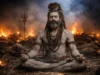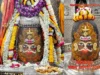



To witness the rituals at the Mahakaleshwar Jyotirlinga in Ujjain is a profoundly moving experience. However, to truly understand the form of Mahakal, one must look beyond the temple and delve into the Esoteric Meaning of Mahakal—the hidden dimensions of Time, Dissolution, and Consciousness. The Mahakal form is not merely a fierce deity to be worshiped; it is a deep philosophical revelation about the ultimate nature of reality, a truth that both terrifies the ego and liberates the soul.
Kala vs. Mahakala: Understanding the Fundamental Distinction
In Sanskrit philosophy, the word Kala has two primary meanings: “Time” and “Darkness/The Void.” In a cosmic sense, Kala is the relentless, forward-moving force of the universe that brings everything into existence, sustains it for a finite period, and inevitably consumes it. It is the principle of mortality to which every created thing, from a microbe to a galaxy, is subject.
Mahakala, on the other hand, means “He who is Greater than Time” or “He who has conquered Time.” In Hinduism, Mahakala symbolizes Lord Shiva’s supreme mastery over time and destruction, emphasizing the cyclical nature of existence. He is the eternal, unchanging, and formless consciousness in which Kala itself is just a fleeting phenomenon.
The Sanskrit term Mahākāla itself is a combination of mahā (“great”) and kāla (“time/death”), which signifies “beyond time”. To worship Mahakal is to acknowledge a reality that is the source of time and also its ultimate point of dissolution.
The Tantric Significance of Bhasma (Sacred Ash)
The bhasma (sacred ash) that is famously used in the Bhasma Aarti is not just ordinary ash. Traditionally, it is the ash from a funeral pyre, or shmashana, and it symbolizes the ultimate, undeniable reality of the physical world. The ash is applied to the idol of Lord Shiva as part of the morning prayers. According to some legends, the ashes used for the Bhasma Aarti were historically brought from the crematorium.
- The Final State of Matter: Ash is the state to which all matter returns after being consumed by the fire of time and transformation. The sacred ash itself is considered to represent the impermanence of life and the eternal nature of the soul. It represents complete detachment and the stark impermanence of the physical form.
- A Symbol of Ultimate Lordship: By smearing his body with the ash of the cosmos, Mahakal demonstrates his absolute lordship over the entire cycle of creation and destruction. In the Shiva Panchakshara Stotram, Shiva is described as being “besmeared with sacred ash”. It is a powerful statement that while the entire universe is his manifestation, he remains eternally untouched and transcendent, the silent witness to his own cosmic play.
The Mystery of the South-Facing (Dakshinmukhi) Form
In Vedic and Agamic temple traditions, the southern direction (Dakshina) is presided over by Yama, the lord of death. It is considered the direction of departure. This is why all sacred temples and idols are meticulously built to face east (the direction of the rising sun and new beginnings) or north (the direction of prosperity).
The Gaze That Conquers Death: The Mahakaleshwar Jyotirlinga in Ujjain is the only one among the twelve Jyotirlingas that defiantly faces south (Dakshinmukhi). This is a profound and powerful tantric statement. This unique feature is upheld by the tantric shivnetra tradition.
It signifies that He is the absolute master of Death itself. His divine gaze falls upon the direction of death, neutralizing its power and control. People worship Mahakaleshwar to prevent untimely death, symbolizing his mastery over mortality.
The worship of Mahakal is not about asking for worldly boons. It is a higher form of devotion that requires immense courage. To grasp the Esoteric Meaning of Mahakal, one must see that this worship is the practice of looking directly at the impermanent nature of life and the inevitability of dissolution — and in doing so, finding a connection to the eternal, fearless, and timeless consciousness that lies beyond it all.For a deeper understanding of ancient Hindu perspectives on time, creation, and dissolution, see this detailed section on Hindu cosmological principles and cyclic time theory.
Frequently Asked Questions
1: What is the specific meaning of Mahakal’s south-facing direction (Dakshinmukhi)?
The Dakshinmukhi (south-facing) direction of the Mahakaleshwar Jyotirlinga is considered unique because the South is the domain of Yama, the Lord of Death. By facing this direction, Mahakal signifies that he is the ultimate master of time and mortality, and devotees who worship him are liberated from the fear of untimely death (Akal Mrityu).
2: Does Mahakal only represent the destruction phase of the cosmos?
No, while Mahakal is most famously associated with Pralaya (Cosmic Dissolution), he actually represents the entire cycle of Time (Kala). He is the ultimate reality that exists before the creation and after the dissolution of the universe, making him the controller of all phases, not just the destructive one.
3: What is the philosophical meaning of the Bhasma Aarti?
The Bhasma Aarti is a symbolic ritual where the deity is anointed with ash. Philosophically, this ritual serves as a reminder of the impermanence of the physical body. The ash is considered non-dual, imperishable, and unchangeable, mirroring the nature of the Lord himself. For seekers wishing to understand this from a meditative and experiential angle, explore this insightful explanation on the spiritual significance of sacred ash in yogic practice.
4: Why is the Bhasma Aarti performed early in the morning?
The Bhasma Aarti is performed every day at around 4:00 AM to awaken the deity. This time corresponds to the Brahma Muhurta, which is the auspicious period roughly two hours before sunrise, considered ideal for spiritual practices.
5: Is Mahakal the same as Shiva’s fierce form, Bhairava?
While both are fierce forms of Shiva associated with destruction, they are not the same. Mahakal is considered a direct epithet of Lord Shiva, showing him as the lord of time and death. Bhairava (Kaal Bhairav) is often viewed as a specific incarnation or a guard/protector, while Mahakal is the unmanifest, ultimate aspect of Shiva that is the controller of Time itself.
For the latest updates on Ancient History, cultural insights, spiritual journeys, and other global events, visit mahakaltimes.com first.