

Few spiritual paths in India provoke as much fascination, fear, and misunderstanding as that of the Aghoris. Often portrayed as dark, extreme, or even dangerous, Aghoris are usually reduced to shocking images rather than understood for their philosophy. But who are Aghoris really—and what spiritual reality lies beneath the myths?
Aghoris are not seekers of horror; they are radical seekers of truth. Rooted deeply in Shaivism, the Aghori path is a fierce discipline aimed at realizing the absolute non-dual nature of existence, where nothing is impure and everything is Shiva. This guide separates myth from reality, explaining who Aghoris truly are, what they believe, and why their path exists.
Who Are Aghoris?
Aghoris are a small, ascetic sect of Shaiva renunciates who follow the philosophy of Aghora—“that which is beyond fear.” They see the entire universe as a manifestation of Lord Shiva, without division into pure and impure.
Unlike mainstream monks, Aghoris deliberately confront what society avoids: death, decay, taboo, and fear. Their aim is not rebellion, but liberation—breaking the deepest psychological and spiritual conditioning that binds humans to duality.
Myth 1: Aghoris Worship Darkness or Evil
This is the most common misconception.
Reality:
Aghoris do not worship darkness or negativity. They worship Shiva in His totality—creation, preservation, and destruction alike. What appears “dark” is simply that which society refuses to face. For the Aghori, denying any aspect of existence is denying Shiva Himself.
According to Encyclopaedia Britannica, Aghora represents the aspect of Shiva “to whom nothing is horrible,” encompassing both terrifying and benevolent forces of nature as one unified reality.
Myth 2: All Aghoris Perform Extreme Rituals
Media often portrays Aghoris as uniformly engaging in shocking practices.
Reality:
Not all Aghoris practice extreme external rituals. Many focus primarily on inner discipline—meditation, mantra, and dissolution of ego. External practices, when present, are symbolic tools meant to destroy fear, not spectacles for shock.
True Aghora is an inner state, not a costume or performance.
Myth 3: Aghoris Reject Society and Humanity
Aghoris are often labeled antisocial or inhuman.
Reality:
While Aghoris renounce social norms, many are known for intense compassion. Historically, Aghoris have served the sick, the dying, and the outcast—people abandoned by society. Seeing Shiva in all beings naturally leads to radical acceptance, not hatred.
The Spiritual Philosophy Behind Aghoris
At the heart of Aghori belief lies a powerful truth:
Nothing is impure. Nothing is outside the Divine.
Key principles include:
- Absolute non-duality (Advaita)
- Dissolution of fear through direct confrontation
- Ego death as the gateway to liberation
- Shiva as immanent in all forms—beautiful or terrifying
This philosophy aligns closely with the Aghora face of Sadashiva, which destroys ignorance and illusion.
Why Aghoris Are Associated with Cremation Grounds
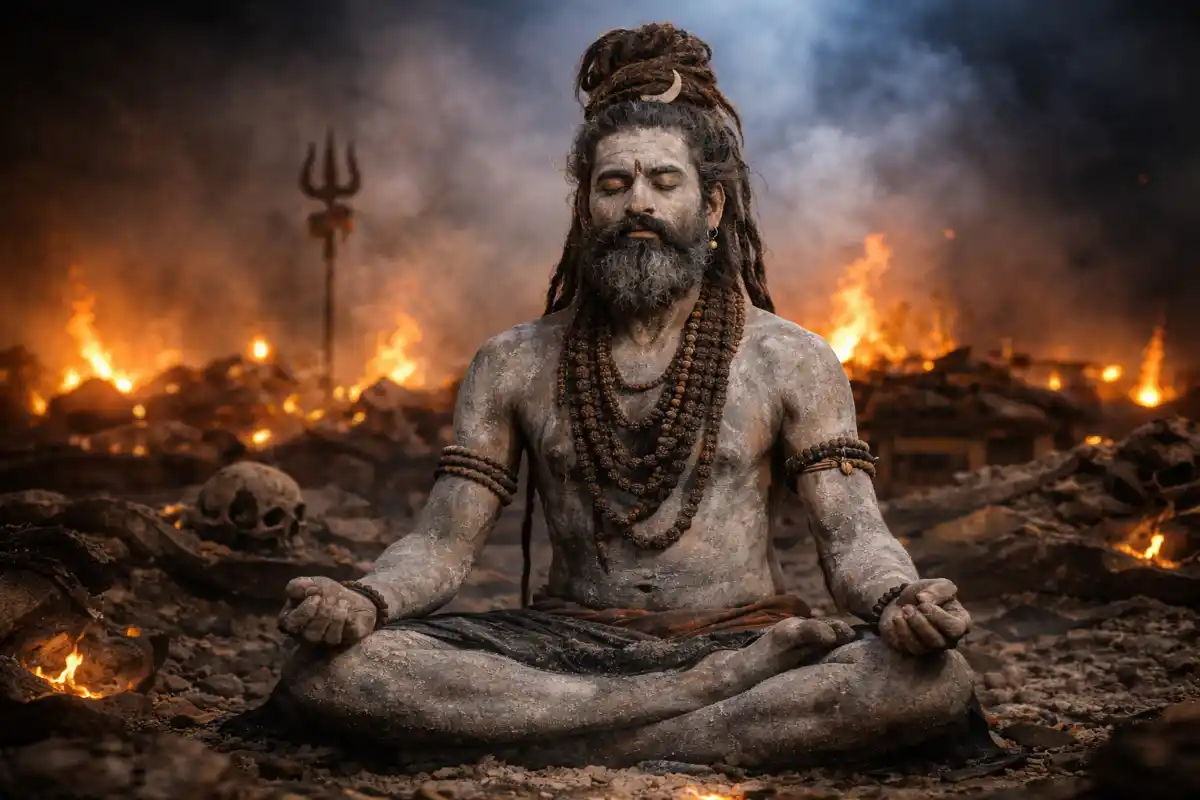
Cremation grounds (shmashana) are not chosen for shock value. They are chosen for truth.
The cremation ground represents:
- The impermanence of the body
- The collapse of ego and identity
- The final equality of all humans
By meditating where all social masks fall away, the Aghori realizes the eternal Self beyond birth and death.
Aghoris vs Common Shaiva Sadhus
While all Aghoris are Shaivas, not all Shaivas are Aghoris.
| Aspect | Common Shaiva Sadhu | Aghori |
|---|---|---|
| Environment | Temples, ashrams | Cremation grounds, solitude |
| Approach | Purity-based | Beyond purity/impurity |
| Focus | Discipline & devotion | Radical non-dual realization |
| Goal | Liberation | Liberation through total acceptanc |
Are Aghoris Dangerous?
In reality, Aghoris are more dangerous to ego and illusion than to people.
They do not seek conflict, conversion, or control. Their path is not recommended for most seekers—it is extremely demanding and requires complete inner renunciation.
The True Goal of the Aghori Path
The aim of the Aghori is moksha—freedom from fear, rebirth, and illusion.
By seeing Shiva in everything, the Aghori dissolves:
- Fear of death
- Attachment to identity
- Hatred, disgust, and desire
What remains is pure awareness—Shiva-consciousness itself.
Aghoris are not symbols of fear—they are mirrors held up to society’s deepest illusions. By walking a path where nothing is rejected, they reveal one of the most uncompromising truths of Shaivism: liberation lies not in escaping reality, but in embracing it completely.
For those willing to look beyond myths, Aghoris stand as living reminders that Shiva exists everywhere—even where we are afraid to look.
Frequently Asked Questions
1.Are Aghoris a cult?
No. Aghoris are an ascetic Shaiva tradition, not an organized cult.
2.Do all Aghoris live in cremation grounds?
No. Some do, some don’t. It depends on the stage of sadhana and the guru’s guidance.
3.Is the Aghori path mentioned in scriptures?
Yes. Aghora philosophy appears in Shaiva Agamas and Tantric traditions.
4.Can ordinary people follow Aghora?
The philosophy can be understood by all, but the lifestyle is not meant for everyone.
5.Do Aghoris worship Lord Shiva?
Yes. Shiva is the sole center of Aghori devotion and realization.
For the latest updates on Ancient History, cultural insights, spiritual journeys, and other global events, visit mahakaltimes.com first.