


Trimbakeshwar Jyotirlinga (श्री त्र्यंबकेश्वर ज्योतिर्लिंग मंदिर), also known as the Trimbakeshwar Shiva Temple, is an ancient Hindu temple in the town of Trimbak, in the Trimbakeshwar tehsil in the Nashik District of Maharashtra, India, 28 km from the city of Nashik and 40 km from Nashik Road. It is dedicated to the Hindu god Shiva and is one of the twelve Jyotirlingas, where the Hindu genealogy registers at Trimbakeshwar, Maharashtra, are kept. The origin of the sacred Godavari River is near Trimbak.
This guide delves into the profound spiritual significance of the Trimbakeshwar Jyotirlinga, highlighting its unique three-faced lingam representing Brahma, Vishnu, and Shiva, its pivotal role as the source of the Godavari, and the rich tapestry of legends, historical resilience, and unique rituals that make it a paramount pilgrimage destination in Maharashtra.
Location and Sacred Environment
- Geographic Details: Trimbakeshwar Shiva Temple is located in the town of Trimbak, Nashik District, Maharashtra. It is situated 28 km from Nashik city and 40 km from Nashik Road.
- Surrounding Hills: The temple is nestled between three hills, namely Brahmagiri, Nilagiri, and Kalagiri. The city of Trimbakeshwar is located at the foot of Brahmagiri hill, whose height is 3000 feet above sea level.
- Proximity to Godavari River’s Origin: The origin of the sacred Godavari River, the second longest river in India, is near Trimbak. Three sources of the Godavari originate from the Brahmagiri mountain. The Kusavarta kunda (sacred pond) in the temple premises, built by Shrimant Sardar Raosaheb Parnerkar, who was the Fadnavis of Indore State, is considered the source of the Godavari River. A bust of Sardar Fadnavis and his wife can be seen on the edge of the kunda. The sacred Kushavarta Kund, a tank near the temple, is believed to be the exact place where the river manifests. Pilgrims bathe here before visiting the shrine, believing that its waters wash away sins and purify the soul.
- Trimbakeshwar as a Center for Hindu Rituals and Vedic Gurukuls: Several Hindu rituals are carried out in Trimbakeshwar, for which pilgrims travel from all over India. Trimbakeshwar town has a large number of Brahmin households and is also a center for Vedic Gurukuls (a kind of boarding school). It also has ashrams and Muths devoted to Ashtanga Yoga, the Hindu art of living. Hindu genealogy registers at Trimbakeshwar are also maintained here by pandits. These registers, known as Vahis, have been maintained since the 9th Century. The records are bound in leather covers and were historically a lifetime occupation for Brahmins.
Unique Deities and Architectural Features
The Trimbakeshwar Temple is renowned for its distinctive features and exquisite architecture.
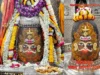
- Three-faced Lingam and its Erosion: The extraordinary feature of the Jyotirlinga located here is its three faces embodying Brahma, Vishnu, and Shiva. They all exist within the hollow space within the Shivalinga. This is why it is called Trimbakeshwar (meaning Lord of the Three Faces). Due to the excessive use of water, the linga has started to erode. It is said that this erosion symbolizes the eroding nature of human society.
- Jeweled Crown: The Lingas are covered by a jeweled crown which is placed over the Gold Mask of Trideva (Brahma Vishnu Shiva). The crown is said to be from the age of Pandavas and consists of diamonds, emeralds, and many precious stones. The crown is displayed every Monday from 4-5 pm.
- Nassak Diamond: The original Nassak Diamond, a large 43.38-carat Golconda Diamond, which adorned the revered linga from at least 1500 to 1817, was eventually stolen by the British. It was believed to be a divine eye of Lord Shiva and was adorned in the Shivalinga around 15th CE. The diamond presently lies with Edward J. Hand, a trucking firm executive from Greenwich, Connecticut, USA. The Nassak Diamond was captured by the British East India Company during the Third Anglo-Maratha War in 1817-1818. While it is believed to have been looted by the British, some sources suggest Peshwa Bajirao II removed it from the temple and gave it away to the East India Company after losing the war, to protect himself.
- Hemadpanthi Architectural Style: The entire black stone temple is known for its appealing architecture and sculpture and is built in the Hemadpanthi architectural style. The temple is at the foothills of a mountain called Brahmagiri. It showcases traditional Maratha-style architecture.
- Temple Tank and Other Water Bodies: The temple tank is called Amritavarshini, which measured 28 m (92 ft) by 30 m (98 ft). There are three other bodies of water, namely Bilvatirtha, Viswanantirtha, and Mukundatirtha. Kushavarta Kund is a sacred tank inside the temple complex where devotees take a holy dip.
- Images of Various Deities: There are images of various deities, namely Ganga, Jaleswara, Rameswara, Gautameswara, Kedarnatha, Rama, Krishna, Parashurama, and Lakshmi Narayana. There are also monasteries of saints in this temple.
Legends of Origin: The Genesis of the Jyotirlinga and Godavari
The profound spiritual significance of Trimbakeshwar is rooted in several ancient legends.
- Jyotirlinga Manifestation (Brahma-Vishnu Supremacy Debate): As per the Shiva Purana, once Brahma (the Hindu God of creation) and Vishnu (the Hindu God of preservation) had an argument in terms of supremacy of creation. To test them, Shiva pierced the three worlds as a huge endless pillar of light, the jyotirlinga. Vishnu and Brahma split their ways downwards and upwards respectively to find the end of the light in either direction. Brahma lied that he found out the end, while Vishnu conceded his defeat. Shiva, then assumed his true form and cursed Brahma that he would have no place in ceremonies while Vishnu would be worshipped till the end of eternity. The jyotirlinga is the supreme partless reality, out of which Shiva partly appears. The Jyotirlinga shrines, thus, are places where Shiva appeared as a fiery column of light. Originally there were believed to be 64 jyotirlingas, while 12 of them are considered to be very auspicious and holy. Each of the twelve jyotirlinga sites take the name of the presiding deity – each considered a different manifestation of Shiva. At all these sites, the primary image is lingam representing the beginningless and endless Stambha pillar, symbolizing the infinite nature of Shiva. Shiva showed himself as a Jyotirlinga on the night of the Aridra Nakshatra. It is believed that a person can see the Jyotirlingas as columns of fire piercing through the earth when he reaches a higher level of spiritual attainment. At the highest level, Shiva is regarded as formless, limitless, transcendent and unchanging absolute Brahman and the primal Atman (soul, self) of the universe.
- Birth of Godavari (Sage Gautama’s Penance):
- Sage Gautama’s Drought Relief: Sage Gautama is a central figure in the story of the Godavari’s origin. It is said that Gautama Rishi once lived in the Brahmagiri hills at Tryambakeshwar with his wife, Ahalya. There was a severe drought that affected the region, and the local people suffered from hunger and thirst. Gautama, the son of Brahma, was able to successfully convince Varuna, the god of oceans, into helping them get rid of a long spell of drought in the Brahmagiri mountains where Gautama was meditating.
- Intense Penance at Brahmagiri Hill: The Ganges was reluctant to come to the region due to the disturbance caused by her descent from the heavens. Sage Gautama performed intense penance and austerities for thousands of years at the peak of Brahmagiri Hill, located in the Trimbakeshwar area. Deeply moved, Lord Shiva commanded the Ganga to descend on Earth at this spot to purify the land and bless all living beings.
- Lord Shiva Directs Ganges: Pleased with his devotion, Lord Shiva agreed to bless Gautama and directed the Ganges to flow in that region. However, the river could not directly flow due to the wrath of Shiva, and instead, the Ganges appeared as a stream and flowed to the earth through the Trimbak hills. This stream eventually became known as the Godavari River. Shiva performed Tandav Nritya on the peak of Brahmagiri hill as a result of which Ganga, later known as Godavari, appeared.
- Gautama’s Purification: The Godavari river is considered sacred, and it is believed that Sage Gautama bathed in its waters to purify himself from the sin of unintentionally killing a cow. This act of penance and purification is a key part of the mythological origin of the river.
- Godavari’s Connection to Vishnu and Shiva: Another legend states that the river Godavari was created by Lord Vishnu in the form of Trivikram (the Vamana avatar), who pressed the earth with his foot to release water, which eventually formed the Godavari River. Some accounts suggest that the river emerged from the feet of Lord Vishnu. Another part of the story involves Lord Shiva, who, when pleased with Sage Gautama’s penance, allowed the Ganges to flow from the heavens and take the form of the Godavari, thus further associating the river with divine blessings.
Historical Journey of the Temple
The Trimbakeshwar Shiva Temple has a rich history marked by destruction, rebuilding, and continuous reverence.
- Destruction by Mughal Ruler Aurangzeb: The current temple was built by Peshwa Balaji Baji Rao after it was destroyed by Mughal ruler Aurangzeb. Aurangzeb’s forces vandalized the ancient Trimbakeshwar Jyotirlinga in 1690, with the intent of crushing the religious motivations of the Maratha empire. The Mughals could not completely destroy these sites including the Trimbakeshwar Jyotirlinga. It is even claimed that the temple was converted into a mosque during Aurangzeb’s reign.
- Current Temple Built by Peshwa Balaji Baji Rao: The present Trimbakeshwar temple was constructed by third Peshwa Balaji Bajirao (1740-1760) on the site of an old temple. The temple was rebuilt in the basalt stone as it is seen today. The Peshwa made a bet on whether the stone surrounding the Jyotirlinga is hollow from the inside or not. The stone was proved to be hollow, and on losing the bet, the Peshwa built a marvelous temple out of it. The construction of the temple was completed between 1755 and 1786 AD.
- British Looting of Nassak Diamond: The Shiva deity of the temple consisted of the famous Nassak Diamond. The Nassak Diamond, a large 43.38-carat Golconda Diamond, was originally extracted from Amaragiri mines in the late 15th century and adorned the Sivalinga in the Trimbakeshwar Shiva Temple from at least 1500 to 1817. It was believed as a Divine eye of Lord Shiva. The British East India Company captured the diamond through the Third Anglo-Maratha War in 1818 and sold it to British jewellers. The diamond presently lies with Edward J. Hand, a trucking firm executive from Greenwich, Connecticut, USA. While popular belief states the British stole it, some accounts suggest Peshwa Bajirao II, after his defeat in 1818, removed the diamond from the temple and gave it to the East India Company to protect himself.
- Genealogy Registers: Hindu genealogy registers at Trimbakeshwar are the genealogy registers of pilgrims maintained here by pandits. These registers, or Vahis, have records of family trees going back up to the 9th Century.
Other Sacred Sites in the Vicinity
- Shri Nilambika/Dattatreya/Matamba Temple: This temple is on top of the Neel mountain. All goddesses (‘Matamba’, ‘Renuka’, ‘Mananmba’) came here to see Parashuram when he was performing penance (tapas). After his penance, he requested all goddesses to stay there and the temple was formed for these goddesses.
- Akhil Bhartiya Shree Swami Samarth Gurupeeth: The Akhil Bhartiya Shree Swami Samarth Gurupeeth, dedicated to Shri Swami Samarth Maharaj, is located 1 km from the Shiva Temple. This temple is a marvelous example of Vastu Shastra.
- Brahmagiri Hill: Brahmagiri Hill, the sacred origin of the Godavari River, offers a mesmerizing trek with breathtaking panoramic views. Many pilgrims trek up to the hilltop Ganga Dwar, where a small cave marks the original mouth of the Godavari.
- Anjaneri Hill: Anjaneri Hill, believed to be the birthplace of Lord Hanuman, is located about 10 km away. The scenic trails and historical significance make it an enriching experience.
Planning Your Pilgrimage
- Nearest Airport: The nearest airport is Ozar Airport in Nashik, about 30 km away. For international travelers, Chhatrapati Shivaji Maharaj International Airport in Mumbai, about 180-200 kilometers away, serves as the closest option.
- Nearest Railway Station: The closest railway station is Nashik Road Railway Station, which is 39 kilometers by road. From the station, taxis and buses are available to reach Trimbakeshwar.
- Road Access: Shri Trimbakeshwar Shiva Temple is 30 kilometers by road from Nashik, and 157 kilometers from Thane. It is well connected by state transport buses. Visitors from Mumbai (around 180 km) and Pune (around 240 km) can reach by road within 4–5 hours. The place is known for its scenic beauty in the rainy/monsoon season.
- Best Time to Visit: The ideal time to visit Trimbakeshwar Temple is between October and March, when the weather is pleasant. The monsoon season (June to September) offers lush green surroundings and breathtaking views.
Other Jyotirlingas in Maharashtra
The Trimbakeshwar Shiva Temple’s lingam is one of the five Jyotirlingas of Maharashtra. Maharashtra is known for having 5 of the 12 Jyotirlingas. The five Jyotirlingas in Maharashtra are:
- Trimbakeshwar Shiva Temple (Nashik)
- Bhimashankar Temple (Pune)
- Grishneshwar Temple (Aurangabad)
- Aundha Nagnath Temple (Hingoli)
- Parli Vaijnath Temple (Beed)
Trimbakeshwar Jyotirlinga, a sacred jewel nestled amidst the picturesque hills near Nashik, stands as a powerful testament to India’s rich spiritual and historical heritage. As one of the twelve revered Jyotirlingas, the Trimbakeshwar Shiva Temple is renowned for its unique three-faced lingam representing the Hindu Trinity—Brahma, Vishnu, and Shiva—and its status as the revered source of the Godavari River, lending it unparalleled significance.
From ancient legends of divine manifestation and sage Gautama’s penance to its resilience against historical destruction and rebuilding by the Peshwas, Trimbakeshwar Jyotirlinga offers a profound pilgrimage experience. This sacred site, where significant Hindu rituals are performed and ancestral genealogies are preserved, continues to draw devotees seeking spiritual solace, purification, and a deeper connection with the timeless essence of Lord Shiva.For a broader understanding of India’s temple architecture and cultural heritage recognized by UNESCO’s list of World Heritage Sites, this Jyotirlinga stands as a living reflection of devotion and craftsmanship through the ages.
Frequently Asked Questions
1: What is unique about the Jyotirlinga at Trimbakeshwar?
The Jyotirlinga at Trimbakeshwar is unique because it features three faces embodying Brahma, Vishnu, and Shiva, making it a representation of the Hindu Trinity. This is an extraordinary feature among the twelve Jyotirlingas. Due to the excessive use of water, the linga has started to erode.
2: What is the origin of the Godavari River?
The Godavari River originates near Trimbak, from the Brahmagiri hills. According to legend, Sage Gautama performed intense penance at Brahmagiri Hill, and Lord Shiva, pleased with his devotion, directed the Ganges to flow there as the Godavari River to alleviate a severe drought and purify Sage Gautama from the sin of unintentionally killing a cow. The Kusavarta kunda in the temple premises is considered its source. According to detailed hydrological research on the Godavari River by the Government of India’s Central Water Commission, this river is not only sacred but also vital to India’s ecology and civilization.
3: Who built the current Trimbakeshwar Temple?
The current Trimbakeshwar Shiva Temple was built by Peshwa Balaji Baji Rao (Nana Saheb) in the 18th century, specifically between 1755 and 1786 AD, after the previous structure was destroyed by Mughal ruler Aurangzeb. The temple was built out of basalt, following a bet by the Peshwa regarding the hollow nature of the stone surrounding the Jyotirlinga.
4: What are the special rituals performed at Trimbakeshwar?
Trimbakeshwar is a significant center for several special Hindu rituals (vidhis) that are carried out for specific purposes, for which pilgrims travel from all over India. These include Narayan Nagbali Puja, Kalsarpa Shanti Puja, and Tripindi Vidhi. Narayan Nagbali puja, for example, is exclusively performed here over three days for reasons such as curing illnesses, overcoming bad times, or for childless couples.
5: Can we see the Nassak Diamond at Trimbakeshwar Temple?
No, the original Nassak Diamond that once adorned the revered linga at Trimbakeshwar Temple was looted by the British during the Third Anglo-Maratha War in 1817-1818. It is no longer at the temple and is currently owned by Edward J. Hand in the USA.
For further exploration of Maharashtra’s spiritual treasures, delve into other [Jyotirlingas in Maharashtra] like Bhimashankar Temple.
For the latest updates on Ancient History, cultural insights, spiritual journeys, and other global events, visit mahakaltimes.com first.