

Why does a Hindu deity accept alcohol as an offering? What secrets lie behind Kalbhairav’s fierce eyes and eternal guardianship of Ujjain?
Kalbhairav, the fearsome yet deeply revered form of Lord Shiva, defies conventional temple worship. In Ujjain, his temple receives daily offerings of liquor—yes, alcohol—as devotion. This ancient ritual has puzzled devotees and scholars alike, sparking debates across centuries.
In this article, we explore The Secret of Kalbhairav, unraveling the mythological, spiritual, and symbolic depths behind this mystic guardian of Ujjain.
Who is Kalbhairav?
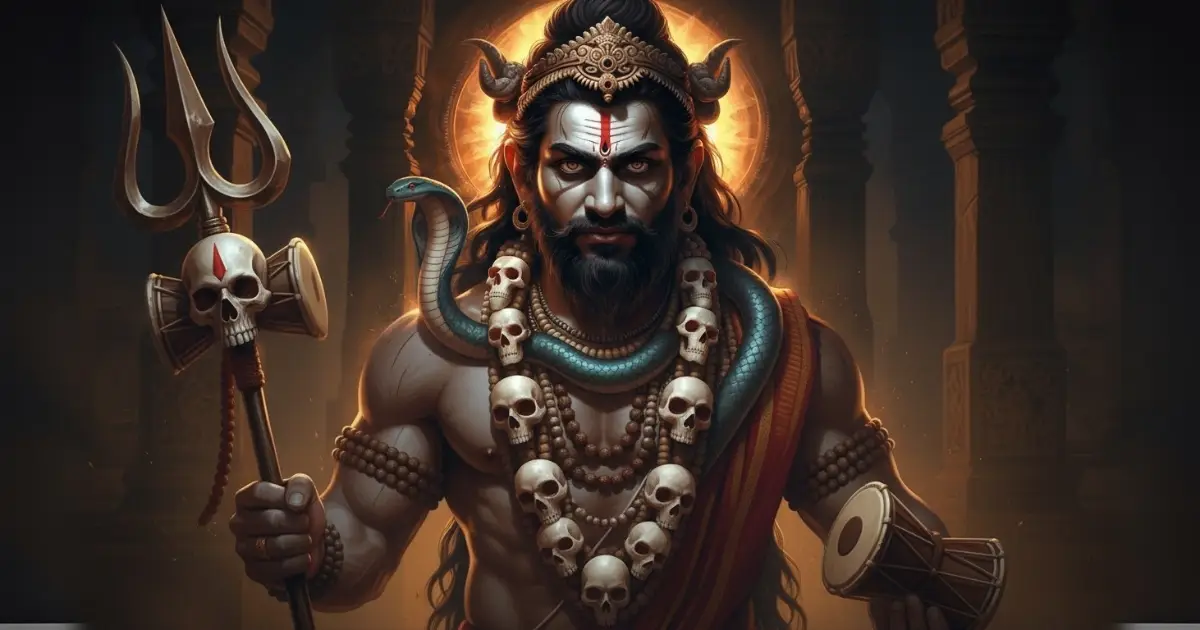
Kalbhairav is a fierce manifestation of Lord Shiva, associated with annihilation, protection, and time (Kaal) itself. In Shaivite tradition, he is both a destroyer of ego and protector of sacred dharma.
- Sanskrit Name: कालभैरव (Kaal + Bhairav = Time + Terrifying.
- Role: He is revered as the guardian deity (Kotwal) of Ujjain, a role assigned to him by Lord Mahakal. Ujjain itself is considered one of the seven Moksha-puris (cities of liberation) and one of the seven sacred cities (Sapta Puri) in Hindu tradition.
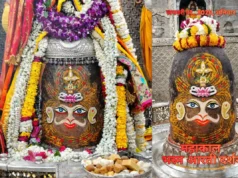
- Temple: The Shri Kalbhairav Mandir is prominently situated on the banks of the Shipra River in Ujjain.
This form is said to patrol the boundaries of consciousness itself—where fear, death, and liberation meet.
Why is Alcohol Offered to Kalbhairav?
Perhaps the most striking ritual at Kalbhairav’s temple is the offering of alcohol. Devotees buy a sealed bottle of liquor from outside vendors and hand it to the priest, who pours the liquor into a shallow cup or plate and places it near the mouth of the idol. The liquor then mysteriously disappears into the statue.
- Scientific Investigations: The exact pathway of the disappearing liquid has baffled many, including scientists and researchers, who have attempted to explain the phenomenon with logic and reason. Theories suggesting a hollow cavity, sponge-like material, or chemical reactions have been proposed but have largely failed to provide conclusive answers. Some reports even state that the idol must be absorbing the liquid into the stone, a theory challenged because it should have eroded or damaged the idol over decades, which it hasn’t. Ultimately, scientists have acknowledged that what happens here is beyond conventional scientific explanation.
- Scriptural and Tantric Symbolism:
- In Tantra and Aghora traditions, substances like alcohol (Madya) are considered part of the Panchamakara rituals (five M’s) and represent ego-breaking tools.
- Offering liquor symbolizes surrendering worldly temptations and attachments to the divine, emphasizing a devotee’s willingness to let go of control and rigid thinking.
- Kalbhairav accepts what society rejects—reminding us that true divinity lies beyond conventional notions of purity and impurity, duality, and judgment. This embodies a fearless connection to primal energy.
Kalbhairav’s Role in Ujjain’s Spiritual Grid
Ujjain is not just a city—it’s a sacred power grid. Kalbhairav stands as the guardian of time and space here.
- Protector of the City: According to local beliefs and legends, Kalbhairav was appointed by Lord Mahakal himself to protect the city, making him the guardian deity (Kotwal) of Ujjain]. It is believed that he watches over the city and ensures its safety from harm or negative forces.
- Pre-Mahakal Darshan: Traditionally, devotees believe that no journey through Ujjain’s spiritual landscape is complete without first seeking blessings at Kalbhairav’s shrine, especially before visiting Mahakaleshwar Jyotirlinga.
- Cosmic Law: His presence is believed to maintain cosmic law, punishing evil and guiding sincere seekers.
- Local Tradition: According to local tradition, it is often said: “Even Death fears Kalbhairav in Ujjain”.
Connection to Aghori Practices
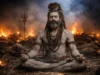
Kalbhairav is closely associated with Aghori sadhus, who are a Hindu monastic order of ascetic Shaivite sadhus and the only surviving sect derived from the Kāpālika tradition. These ascetics often dwell in cremation grounds and embrace spiritual truths beyond conventional social norms.
- Ritual Reflection: The temple rituals, including the liquor offering, reflect Aghori philosophy, which aims at transcending concepts of good/evil, pure/impure, and duality.
- Mystic Symbolism: Elements like liquor, skulls (kapala), and ash (bhasma) are integral to this mystic symbolism for Aghoris, representing detachment and the non-dual nature of reality.
- Ishta Devata: Kalbhairav is considered a primary Ishta Devata (personal deity) for many Aghoris, embodying fearlessness and absolute surrender.
Historical Legends of Kalbhairav in Ujjain
- Legend 1: Brahma’s Arrogance: A prominent legend, mentioned in texts like the Shiva Purana and Skanda Purana, states that Kalbhairav was created by Lord Shiva to punish Brahma’s arrogance. When Brahma falsely claimed supremacy or uttered a lie, Shiva, in a fierce form (often identified as Bhairava), decapitated one of Brahma’s five heads. The severed head then became stuck to Bhairava’s hand, where it remained as a skull, destined to serve as his begging-bowl (kapala), leading him to wander the earth to atone for the sin of Brahmahatya (killing a Brahmin). It is believed that his sin was absolved upon reaching Varanasi, and he decided to stay in Ujjain to protect the city.
- Legend 2: Temple Restoration: The present-day temple structure was built over the remains of an older temple, believed to have been constructed by an obscure king named Bhadrasen, and is mentioned in the Avanti Khanda of the Skanda Purana. The current temple, exhibiting Maratha architectural influence, underwent significant restoration by the Maratha general Mahadaji Scindia (or Ranoji Scindia in some accounts) in the 18th century. After the Maratha defeat in the Third Battle of Panipat (1761 CE), Mahadaji Scindia offered his turban to Kalbhairav, praying for victory, and subsequently restored the temple after successfully resurrecting Maratha power in North India.
The temple is a living legend—visited daily by locals, mystics, and curious seekers alike.
The Secret of Kalbhairav isn’t just about alcohol—it’s about transcending judgment, fear, and illusion. Ujjain’s Kalbhairav Temple reminds us that divinity doesn’t always look “sattvic”—sometimes, it’s fierce, raw, and liberating. It stands as a powerful symbol of the ultimate truth: that the divine encompasses all aspects of existence, pure and impure, beautiful and terrifying. This unique sanctuary continues to draw seekers into its mystery, challenging conventional perceptions and offering a profound journey into the heart of Shaivite spirituality.To know more about Bhairava and his role in Shaivism, you may read this comprehensive article on Hindu deities.
Frequently Asked Questions (FAQs)
1:Why is alcohol accepted at Kalbhairav Temple?
Alcohol is accepted at Kalbhairav Temple primarily because it symbolizes the surrender of ego and worldly desires, especially in Tantric and Aghori traditions. Kalbhairav accepts all offerings, even those considered impure by conventional society, emphasizing the non-dualistic philosophy that true divinity transcends all judgments.For a deeper understanding of these Tantric traditions, you can explore this overview of tantric rituals and Panchamakara practices.
2:Where does the alcohol go after being offered?
The exact pathway of the disappearing alcohol remains untraceable. Despite numerous investigations by scientists and researchers using cameras and various tests, the mystery has never been conclusively solved. Devotees firmly believe that Lord Kalbhairav himself consumes the alcohol.
3:Is it allowed to drink alcohol inside the temple?
No. While liquor is offered to the deity, consumption of alcohol by devotees inside the temple premises is strictly forbidden. Sealed bottles are purchased from outside vendors and given to the priest for offering.
4:What is Kalbhairav’s connection to Shiva?
Kalbhairav is a ferocious avatar or a fierce manifestation of Lord Shiva. He represents Shiva’s power of annihilation, especially the destruction of time, ego, and falsehood, and is often associated with the protection of sacred places and dharma.
5:Can women visit Kalbhairav Temple?
Yes, absolutely. The Kalbhairav Temple is open to all genders and faiths, and women can visit and offer prayers without any restrictions. Respectful behavior and adherence to general temple etiquette are encouraged.
Ready to dive deeper into Ujjain’s mystic heart?
Read our article on [Shiva & the Sand Shivling] — a tale of childlike devotion and divine grace.