

The Story of the Hunter and Bael Leaves, or the Shikari, is one of the most beloved and widely told tales associated with the festival of Maha Shivratri. It is a powerful and heartwarming narrative from the Shiva Purana that beautifully illustrates a core principle of Shaivism: Lord Shiva is Bholenath, the innocent Lord, who is so compassionate that he accepts even an unintentional act of devotion and grants the highest liberation. This is the story of how a night of fear and survival transformed into a night of ultimate grace.
The Hunter’s Desperate Night
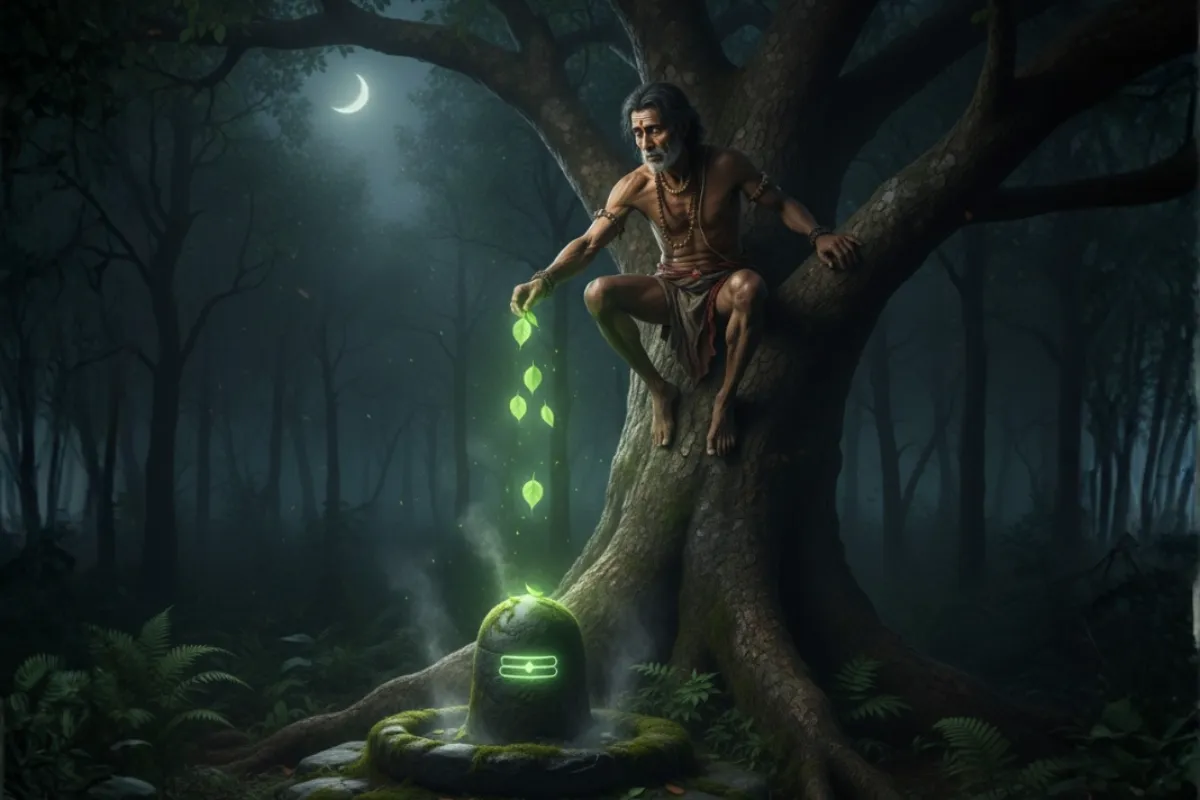
The story, primarily narrated in the Kotirudra-saṃhita section of the Shiva Purana, begins with a hunter named Gurudruh who lived in a forest. One dark evening, having hunted all day without success, he was desperate to find food for his hungry family. He came to a lake, and knowing that animals would come there to drink water, he decided to climb a nearby tree to wait for his prey. To get a clear line of sight, he began to pluck the leaves from the branches around him and drop them to the ground. The tree he had climbed, unknown to him, was a sacred Bael tree (Bilva).
The Unintentional Worship
As the night grew colder, the hunter shivered, and to keep himself warm and awake, he kept moving. His movements caused his water pot to leak, and water dripped down from the branches. Throughout the long night, he remained awake, hungry, and anxious, thinking only of his family and his next meal.
He was completely unaware of the miraculous series of events his simple actions had set in motion, which constitutes a perfect Shiva puja as described in the scriptures:
- The Sacred Place: At the base of that specific Bael tree was a hidden Shiva Lingam.
- The Sacred Offering: The leaves he was plucking and dropping were none other than the sacred Bael leaves (Bilva Patra), the most beloved offering to Lord Shiva.
- The Sacred Bath (Abhishekam): The water that dripped from his pot was falling directly onto the Lingam, performing a continuous, gentle Abhishekam.
- The Sacred Vigil (Jagran): By staying awake all night, he was unknowingly observing the sacred all-night vigil of Maha Shivratri.
Without any devotion in his heart, driven only by his worldly needs, the hunter had unknowingly performed the complete, perfect worship of Lord Shiva on the most auspicious night of the year.
The Moment of Divine Grace
The next morning, as the sun rose, a deer came to the lake to drink water. The hunter raised his bow and was about to shoot. At that moment, Lord Shiva, who was immensely pleased by the hunter’s unintentional night-long worship, manifested before him.
Seeing the radiant, compassionate form of the Lord, all the cruelty and roughness in the hunter’s heart instantly melted away. He dropped his bow, fell at Shiva’s feet, and begged for forgiveness.
Lord Shiva smiled and told the hunter that his actions during the night had washed away all his past sins. He bestowed upon the hunter the name Guh (or Guha), blessed him with wisdom and devotion, and granted him and his family a place in his divine abode, Shivaloka, after their lives were over. The hunter Guha later became a revered figure and is known to be a friend of Lord Rama.
The Story of the Hunter and Bael Leaves beautifully teaches us that no act, however small or unintentional, goes unnoticed by the divine. This sacred leela is a story of hope, assuring us that the Lord’s compassion is so boundless that it can find even the slightest glimmer of goodness and transform a person’s life forever. Such tales of devotion and divine grace are deeply rooted in ancient temple architecture and cultural traditions preserved across India
Frequently Asked Questions
Q1: Why did Lord Shiva accept the hunter’s worship, even though it was unintentional?
This story highlights Shiva’s title of Bholenath, the ‘Innocent Lord’, who is easily pleased by the purity of an action, rather than the conscious, ego-driven intention. The hunter’s act of staying awake all night, dropping Bael leaves, and offering water satisfied all the ritual requirements for a perfect Maha Shivratri vrat (vow).As mentioned in traditional Hindu scriptures and detailed studies on Shaivism, Shiva, in his infinite compassion, chose to accept the deed itself as a complete offering.
Q2: What three main unintentional acts of devotion did the hunter perform?
The hunter performed three main acts that constituted a complete Shiva Puja:
- Jagran (All-Night Vigil): His desperate need to stay awake to hunt fulfilled the sacred all-night vigil of Maha Shivratri.
- Bael Patra Offering: He unknowingly plucked and dropped the sacred Bael leaves onto the Shiva Lingam.
- Abhishekam (Water Bath): The water dripping from his pot performed a gentle, continuous bath on the Lingam.
Q3: What was the hunter’s name before and after receiving Shiva’s grace?
The hunter’s name was Gurudruh (or Lubdhaka) before Shiva’s grace. Lord Shiva bestowed upon him the new name Guh (or Guha), marking his transformation from a harsh hunter to a wise devotee. Guha is also mentioned as a friend of Lord Rama in the Ramayana.
Q4: In which Purana can the original story of the hunter and Bael leaves be found?
The original story is recorded in the sacred Shiva Purana, specifically within the Kotirudra-saṃhita section.
Q5: What is the main lesson from the story of the hunter and Bael leaves?
The main lesson, or leela, is the power of unintentional devotion and Shiva’s boundless compassion, symbolized by his title Bholenath. It teaches that the purity of action and the sanctity of the moment (like Maha Shivratri) are recognized by the divine, regardless of conscious, ritualistic intent.
For the latest updates on Ancient History, cultural insights, spiritual journeys, and other global events, visit mahakaltimes.com first.