
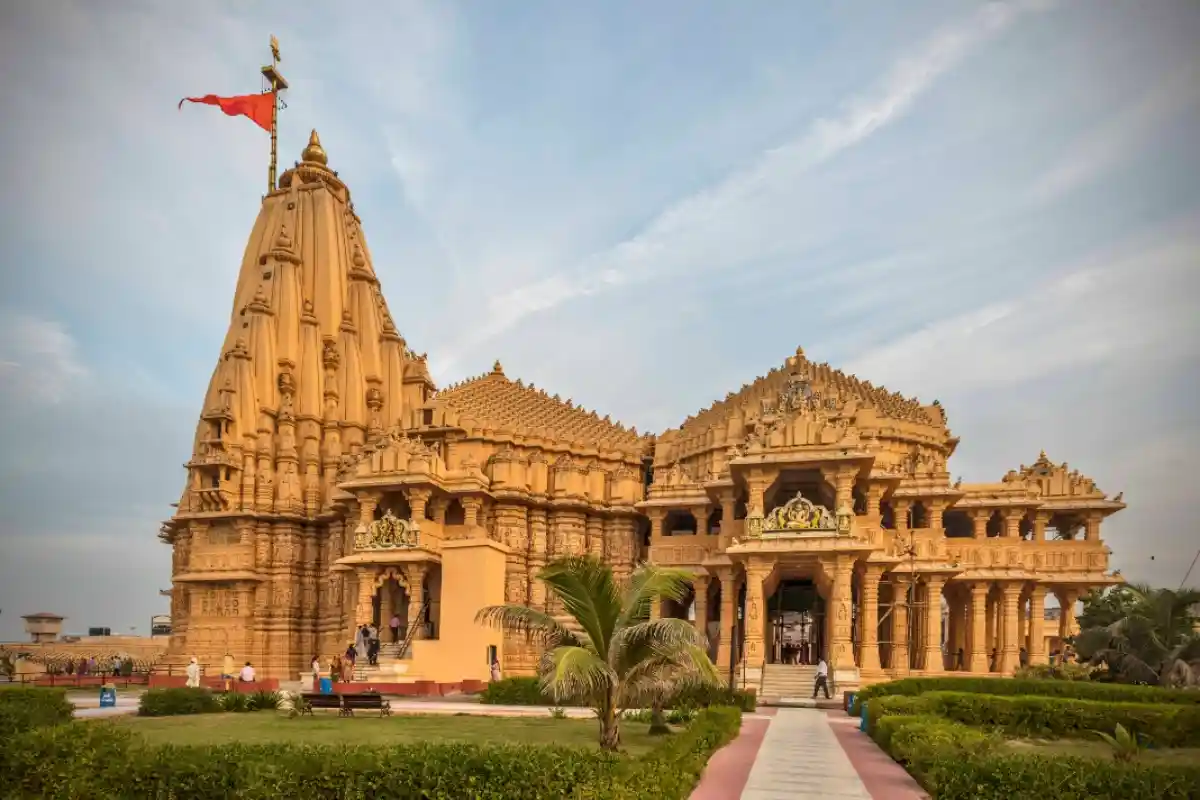

The Somnath Temple, located on the western coast of Gujarat, stands as a powerful symbol of resilience and devotion. Revered as the first among the twelve sacred Jyotirlinga shrines of Lord Shiva, the Somnath Temple holds immense spiritual importance for devotees across India.
Its history is a testament to faith that has witnessed countless destructions and reconstructions over millennia. This comprehensive guide explores the profound spiritual significance, the captivating architectural evolution, and the enduring legacy of the Somnath Temple, providing a complete overview for pilgrims and history enthusiasts alike.
What is the Somnath Temple?
The Somnath Temple is a prominent Hindu temple situated in Prabhas Patan, Veraval, in the Gir Somnath district of Gujarat, India. It holds immense religious importance as it is considered the first among the twelve Jyotirlinga shrines of Lord Shiva. The name “Somnath” literally translates to “Lord of the Soma” or “moon,” while the site itself is also known as “Prabhasa,” meaning “place of splendor.”
Ancient Hindu texts, including the Mahabharata and Bhagavata Purana, mention Prabhas Patan as a tirtha (pilgrimage site) on the coastline of Saurashtra, indicating its historical sanctity. The site’s ancient spiritual significance is further enhanced by its location at the Triveni Sangam, the confluence of three rivers: Kapila, Hiran, and the mythical Saraswati.
According to legend, Soma, the Moon god, was cursed and lost his luster, which he regained by bathing in the Saraswati River at this very spot. The result is said to be the waxing and waning of the moon. This event is believed to be the reason for the waxing and waning of the moon, giving rise to the name Someshvara, “the lord of the moon.”
The Enduring History of Somnath Temple
The exact timeline of the first Somnath Temple remains unclear, with estimates suggesting its existence between the early centuries of the 1st millennium and the 9th century CE. Pauranic traditions suggest that the Moon god Soma built the first temple in gold, followed by Ravana in silver, Lord Krishna in wood, and King Bhimdev in stone.
However, archaeology has not found traces of an early temple, though there was a settlement there. Mentions of Someshvara appear in records from the 9th century, with the Gurjara-Pratihara king Nagabhata II visiting tirthas in Saurashtra, including Someshvara. The Chaulukya (Solanki) king Mularaja is believed to have constructed the first temple dedicated to Soma before 997 CE.
The Somnath Temple has endured a history marked by repeated destruction and reconstruction. One of the most significant attacks occurred in January 1026 CE when Mahmud of Ghazni, a Turkic Muslim ruler, raided the Somnath temple, desecrated its Jyotirlinga, and plundered 20 million dinars.
This event is confirmed by 11th-century Persian historian Al-Biruni, who occasionally accompanied Mahmud’s troops. Following this, King Bhimdev I is said to have rebuilt the temple between 1026 and 1042 AD. Later, in 1169, the Chaulukya king Kumarapala rebuilt the temple using “excellent stone and studded it with jewels,” replacing a decaying wooden temple.
Further devastations occurred with Alauddin Khalji’s army, led by Ulugh Khan, sacking the temple in 1299. Subsequently, the Chudasama king Mahipala I rebuilt the temple in 1308, and the lingam was installed by his son Khengara between 1331 and 1351. Further destructions include those in 1395 by Zafar Khan, the last governor of Gujarat under the Delhi Sultanate, and in 1451 by Mahmud Begada, the Sultan of Gujarat. In 1665 and again in 1706, Mughal emperor Aurangzeb ordered its destruction and conversion into a mosque.
The 19th century saw colonial-era historians and archaeologists actively studying the Somnath temple ruins, which showed a historic Hindu temple being partly converted into an Islamic mosque. In 1842, Governor-General Lord Ellenborough issued the “Proclamation of the Gates,” ordering the return of sandalwood gates believed to have been taken by Mahmud of Ghazni from Somnath. However, these gates, retrieved from Mahmud’s tomb in Ghazni, Afghanistan, proved to be of deodar wood, not sandalwood, and were not of Gujarati style.
After India gained independence, the reconstruction of the Somnath Temple became a symbol of national revival. India’s first Deputy Prime Minister, Vallabhbhai Patel, ordered the temple’s reconstruction on November 12, 1947, envisioning it as a symbol of cultural pride. Mahatma Gandhi endorsed the plan but suggested that funds should be collected from the public rather than the state.
The ruins were cleared in October 1950, and the present temple was completed in May 1951, with President Rajendra Prasad performing the installation ceremony. Today, a pilgrim corridor is under planning, involving the removal of encroachments and land reclamation.
Architectural Grandeur: Maru-Gurjara Style
The present Somnath Temple is a masterpiece of Māru-Gurjara architecture, also known as the Chaulukya or Solanki style. This style, prominent in Gujarat and Rajasthan from the 11th to 13th centuries, is characterized by a “Kailash Mahameru Prasad” form and intricate carvings. It reflects the exceptional skill of the Sompura Salats, master masons from Gujarat.
The architect behind the modern Somnath Temple was Prabhashankarbhai Oghadbhai Sompura, who meticulously integrated recoverable parts of previous structures into the new design between the late 1940s and early 1950s. The current temple is intricately carved, featuring a two-level structure with a pillared mandapa and 212 relief panels. The temple’s śikhara, or main spire, rises 15 meters (49 ft) in height above the sanctum, and it has an 8.2-meter-tall flag pole at the top.
Archaeological excavations, particularly those led by B.K. Thapar in 1950–51, unearthed substantial evidence of a 10th-century or earlier large temple, which Thapar estimated to be from the 9th century. These findings, including ruins with ancient Brahmi scripts and later proto-Nagari and Nagari scripts, confirm the antiquity of the Somnath-Patan site through much of the 1st-millennium.
Historical accounts from the 19th century, such as those by British officers Alexander Burnes and Captain Postans, and later Henry Cousens, documented the temple’s ruined state and its partial conversion into a Muslim structure. These reports highlight the “exceedingly richly carved” nature of the destroyed temple, with elements showing influences of the late Maha-Maru style.
Today, while many reliefs are mutilated, an original Nataraja (Tandava Shiva) with chopped arms and a defaced appearance can still be seen on the south side. Traces of Shiva-Parvati and Surya iconography are also visible on the south and southwest sides of the temple, along with sections showing “beautiful vertical mouldings.”
Pilgrimage to Somnath: Rituals, Festivals & Modern Amenities
The Somnath-Prabhasa tirtha has been a revered pilgrimage site for Hindus since ancient times, attracting devotees from all over India.
Darshan and Aarti Timings:
- Darshan: 6:00 AM to 10:00 PM daily
- Aarti: 7:00 AM, 12:00 Noon, and 7:00 PM daily
Pilgrim Guidelines:
- Dress Code: Modest attire is required. Men typically wear traditional dhoti-kurta or trousers with a shirt. Women can opt for sarees, salwar-kameez, or other traditional suits, ensuring upper arms and legs are covered. Shorts, mini-skirts, sleeveless tops, and revealing clothing are not permitted.
- Electronic Devices: Mobile phones, cameras, smartwatches, and other electronic gadgets are strictly prohibited inside the main temple premises. Free cloakroom facilities are available for storage near the entrance.
- Footwear: Must be removed before entering the temple.
Festivals and Events:
The temple celebrates major Hindu festivals with great splendor, including Mahashivratri and Kartik Purnima. A captivating sound-and-light show, “Jay Somnath,” narrates the temple’s history nightly from 8:00 PM to 9:00 PM (except during monsoon/rainy season).
Facilities for Pilgrims:
- The Shree Somnath Trust provides various accommodation options, including multiple guest houses and economical dormitories, some with sea-facing rooms.
- Wheelchairs and golf carts are available for physically challenged individuals and senior citizens at the main gate, along with lift facilities inside the temple.
- Online Darshan and E-puja facilities are also provided for devotees worldwide.
- For those wishing to explore further, a Tirth Darshan Bus facility takes pilgrims to nearby significant temples and sites like Bhalka Tirth and Dehotsarg Tirth at nominal charges.
Connectivity:
Somnath is well-connected by air, train, and road, making it accessible for pilgrims from various regions.
- Air: The nearest airport is Diu Airport (DIU), approximately 65-85 km away, with taxis and buses readily available. Other nearby airports include Rajkot (around 200 km) and Porbandar (around 120 km).
- Train: The nearest railway station is Somnath Railway Station, just 0.5 km from the temple. Veraval Railway Station, about 7 km away, is also well-connected to major cities like Ahmedabad, Dwarka, and Junagadh.
- Road: Somnath is easily reachable by state and national highways, with regular bus services from major cities in Gujarat.
The Somnath Temple stands not merely as an architectural marvel but as a profound testament to unwavering faith and resilience across centuries. Its journey, marked by repeated demolitions and subsequent glorious reconstructions, mirrors the enduring spirit of Hindu devotion.
As the first among the twelve Jyotirlingas, the Somnath Temple continues to draw countless pilgrims seeking spiritual solace and a connection to its rich history and divine aura. Experiencing the grandeur and spiritual vibrance of the Somnath Temple is a truly transformative journey. For a deeper overview of Jyotirlinga temples and their cultural significance, you can explore this detailed reference on their legends and importance (Jyotirlinga).
FAQ Section
1: What are the darshan timings for Somnath Temple?
The Somnath Temple is open for Darshan from 6:00 AM to 10:00 PM daily.
2: Is photography allowed inside Somnath Temple?
No, photography is strictly prohibited inside the Somnath Temple premises. Lockers are available for storing electronic gadgets at the entrance.
3: How many times has the Somnath Temple been destroyed and rebuilt?
The Somnath Temple has been destroyed and rebuilt numerous times throughout its history, with historical records indicating multiple reconstructions after invasions and desecrations by various rulers over the centuries.
4: What is the architectural style of the present Somnath Temple?
The present Somnath Temple is built in the Māru-Gurjara style, also known as the Chaulukya or Solanki style of Hindu temple architecture, characterized by intricate carvings and a “Kailash Mahameru Prasad” form.
5: What is the significance of Somnath as a Jyotirlinga?
Somnath is revered as the first among the twelve Jyotirlinga shrines of Lord Shiva, making it an exceptionally sacred pilgrimage site. It is believed that visiting and worshipping here grants immense spiritual benefits and helps in attaining liberation. To place Somnath within India’s rich tradition of sacred journeys, you may refer to this cultural heritage listing of Kumbh Mela which showcases the scale and importance of Hindu pilgrimage practices. (Kumbh Mela – UNESCO Intangible Cultural Heritage).
6: What facilities are available for pilgrims at Somnath Temple?
The Shree Somnath Trust offers guest houses, dormitories, wheelchairs and golf carts for the physically challenged and seniors, lift facilities, online Darshan, E-puja, and a Tirth Darshan bus service for nearby attractions.
To further explore the sacred sites of Gujarat, delve into our guide on the [Dwarka Somnath Pilgrimage Circuit].