

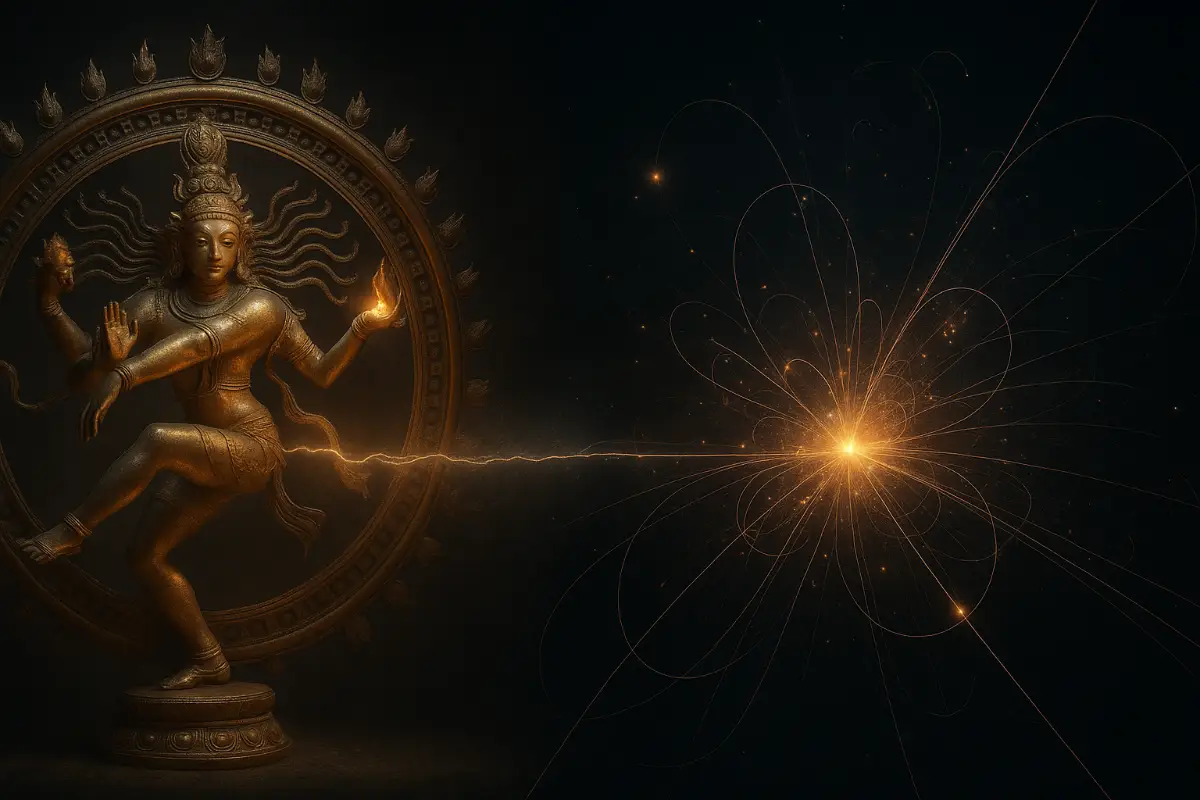

For millennia, the concepts central to Shaivism—the cosmic dance of Nataraja, the intuitive power of the third eye, the vibrational energy of mantras—have been a source of profound spiritual inspiration. To the modern, rational mind, these can often seem like beautiful myths or metaphors. However, as modern science, particularly quantum physics and neuroscience, delves deeper into the fundamental nature of reality, it is uncovering truths that resonate uncannily with the wisdom of ancient sages. This guide is an exploration of this fascinating intersection, often described as the dialogue between Shiva and Science. We will investigate how concepts central to Shaivism are not at odds with science, but are often describing the same universal truths, simply in a different language.
The Cosmic Dance of Nataraja and Quantum Physics
- Ancient Concept: The Ananda Tandava of Nataraja is a powerful symbol of the constant, dynamic, and rhythmic cycle of creation and destruction that is the very basis of our universe. Shiva dances, and the universe comes into being; he stops, and it dissolves into him. This cosmic dance of Shiva symbolizes Shakti, or life force, and the perpetual cycle of creation, preservation, destruction, illusion, and release.
- Modern Parallel: In the 20th century, physicists discovered that at the subatomic level, the universe is not a static collection of things, but a ceaseless dance of energy. Particles are constantly being created and destroyed in the quantum field. The renowned physicist Fritjof Capra, upon seeing a Nataraja statue, famously noted, “Every subatomic particle not only performs an energy dance, but also is an energy dance; a pulsating process of creation and destruction… For the modern physicists, then, Shiva’s dance is the dance of subatomic matter”. The installation of a 2-meter tall statue of Shiva Nataraja at CERN, the European Organization for Nuclear Research in Geneva, in 2004, symbolizes this profound metaphor. A special plaque next to the statue explains this significance with quotations from Capra’s “The Tao of Physics”.
The Third Eye (Ajna Chakra) and the Pineal Gland
- Ancient Concept: Shiva’s Third Eye, or the Ajna Chakra, is the eye of inner wisdom, intuition, and a gateway to higher states of consciousness that perceive reality beyond duality. In Hindu and Buddhist philosophies, the ‘third eye’ is a mystical and esoteric concept related to mystical awakening or enlightenment.
- Modern Parallel: Neuroscience has focused intently on the pineal gland, a tiny, light-sensitive, pine-cone-shaped organ located in the geometric center of the brain—the exact anatomical location ascribed to the Ajna Chakra. The pineal gland produces key neurochemicals like melatonin, which regulates circadian rhythms, and is believed to be involved in meditative and mystical states. Some researchers also suggest a link between pineal gland’s N,N-dimethyltryptamine (DMT) biosynthesis and near-death experiences. This suggests ancient yogis had a deep, intuitive understanding of human neurobiology.
Mantras, Vibrations, and the Science of Cymatics
- Ancient Concept: Mantras like “AUM” are not just words but sacred vibrations (Nada Brahman) that have the power to alter consciousness and affect the material world. The universe itself is said to have been born from a primordial sound.
- Modern Parallel: The scientific field of Cymatics visually demonstrates how sound vibrations organize matter. Cymatics, derived from the Greek word ‘Kyma’ meaning ‘wave,’ is the study of visible sound and vibration patterns. When sound waves pass through a medium like water or sand on a vibrating plate, they create distinct, often beautiful, complex, and stable geometric patterns known as Chladni figures. This phenomenon, extensively studied by Swiss physician Hans Jenny in the 1960s, scientifically validates the ancient principle that sound has a creative, formative power, lending credence to the idea that the universe is built on a foundation of specific vibrational frequencies.
The Shivling and the Concept of a Singularity
- Ancient Concept: The Shivling represents the formless (Nirguna) divine energy emerging from a point-like source or void (Shunya) to create the entire universe. It is the form emerging from the formless, symbolizing Shiva’s infinite nature and the cosmic pillar of energy that represents the transcendent essence of Shiva. The word “Lingam” itself comes from Sanskrit roots “li” (dissolution) and “gam” (emergence), signifying creation and dissolution.
- Modern Parallel: In cosmology, the Big Bang theory posits that the entire universe emerged from an infinitely dense and hot point called a singularity approximately 13.7 billion years ago. Both concepts describe the entire cosmos emerging from a single, dimensionless point, representing the ultimate source of all matter and energy. Some modern interpretations draw parallels between the Shivling’s form and a black hole’s singularity and event horizon, suggesting an intuitive understanding of cosmic structure and dynamics in ancient wisdom.
The convergence of ancient spiritual wisdom with modern scientific discoveries offers a compelling narrative, suggesting that humanity’s quest to understand reality has always circled similar profound truths. From the rhythmic interplay of creation and destruction embodied by Nataraja to the intricate workings of the pineal gland, the vibrational power of mantras, and the cosmological symbolism of the Shivling, Shaivism provides conceptual frameworks that resonate deeply with cutting-edge scientific theories.
This guide serves as an introduction to this fascinating dialogue, inviting us to appreciate how Shiva and Science together, though speaking different languages, ultimately explore the same universal essence of existence. For further context, the Stanford Encyclopedia of Philosophy also explores how ancient metaphysical ideas often intersect with modern scientific perspectives.
Frequently Asked Questions on Spirituality and Science
1: Is the Nataraja statue at CERN related to the Higgs Boson?
The Nataraja statue at CERN (The European Organization for Nuclear Research) was a gift from the Indian government in 2004, celebrating its long association with India. It is a symbolic gesture acknowledging the profound philosophical parallels between Shiva’s cosmic dance of creation and destruction and the “cosmic dance” of subatomic particles that physicists study. While not directly scientifically related to the Higgs Boson itself, it serves as a powerful metaphor for modern particle physics, including the dynamic equilibrium of the universe. The Higgs boson, often called the “God Particle,” is a fundamental particle that gives other particles mass, a discovery documented in detail by Encyclopædia Britannica.
2: Can science “prove” the existence of the Third Eye?
Science cannot “prove” a spiritual concept like the Third Eye in a mystical sense. However, neuroscience has confirmed the existence of its biological parallel, the pineal gland, located in the geometric center of the brain. Science can study the gland’s functions, its sensitivity to light, and its role in producing neurochemicals like melatonin, which are associated with meditative and mystical states, showing a remarkable resonance with ancient yogic wisdom.
3: Is there any scientific basis for the healing effects of Rudraksha beads?
Yes, scientific studies have indicated that Rudraksha beads possess specific electromagnetic and dielectric properties. These properties allow them to interact with the human body’s bio-electric field, helping to stabilize erratic impulses caused by stress. Research by Dr. Subhas Rai and others has suggested that Rudraksha beads can influence brain chemicals, calm the nervous system, lower blood pressure, and improve concentration, providing a scientific basis for their reported benefits. Rudraksha beads are the dried seeds of the Elaeocarpus ganitrus tree.
4: Is the Shivling really a nuclear reactor?
No, the Shivling is not a literal nuclear reactor. This comparison is a modern theory based on parallels in principles, suggesting an intuitive understanding in ancient times. The theory posits that the Shivling’s design, its placement often on geomagnetic hotspots, and the practice of abhishekam (pouring water or other liquids) show a deep, intuitive understanding of energy generation and stabilization, similar to the principles used in modern nuclear science. However, these remain theories drawing parallels rather than direct scientific evidence of a nuclear reactor.
5: Are the medicinal properties of plants like the Bael leaf a coincidence?
From a scientific perspective, the medicinal properties of plants like the Bael (Aegle marmelos) leaf are due to specific chemical compounds present in them, such as tannins, alkaloids, and flavonoids, giving them antibacterial, antiseptic, anti-inflammatory, and antioxidant qualities. From a spiritual perspective, ancient sages had a highly developed intuitive sense (jnana) that allowed them to understand the properties of the natural world. They encoded this wisdom into sacred rituals, like offering Bael leaves to Lord Shiva, to ensure its preservation and respect. Bael leaves are traditionally offered to Shiva because their trifoliate structure is believed to symbolize his trident or the holy trinity of Brahma, Vishnu, and Mahesh.
To delve deeper into the vast and complex world of Hindu spiritual traditions, explore our guide on [The Esoteric Secrets of Tantra].