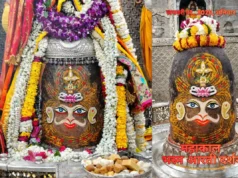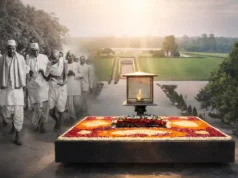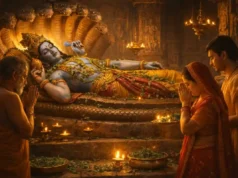



When you step into Ujjain, the temples catch your eyes, but it’s the spaces between them that hold your soul. These are the Sacred Spaces of Ujjain, where every river bend, tree, and ghat hums with sacred memory. Ujjain, located on the banks of the Shipra River, is an ancient city in Madhya Pradesh, India, considered one of the seven sacred cities (Sapta Puri) in Hindu tradition. It stands as the sacred seat of Lord Mahakal, the destroyer of time.
But beyond Mahakaleshwar lies a web of powerful temples, each soaked in divine legends, rituals, and vibrations that awaken the soul. From the mysterious Kal Bhairav, who drinks liquor, to the glowing Deep Stambhs of Harsiddhi Mata, Ujjain invites every seeker to walk its ancient mandir-marg (temple path).
In this guide, we explore 5 sacred rituals that define the soul of Ujjain and guide seekers on their journey to Lord Mahakal.
Ram Ghat – The Spiritual Heartbeat of Ujjain
- Location: Ram Ghat is situated on the picturesque banks of the sacred Shipra River, near the Mahakaleshwar Temple.
- Importance: It is considered the epicenter of the Simhastha Kumbh Mela in Ujjain, where millions of devotees gather every 12 years for a holy dip. It is one of the four official Kumbh Mela sites in India.
- Evening Aarti: Every evening, Ram Ghat comes alive with a stunning aarti ritual involving lights, bells, and mantras, creating a deeply spiritual and mesmerizing atmosphere.
- Rituals: Pilgrims perform various sacred rituals here, including snan (holy dip) for purification, Deep Daan (offering of lamps), and Shraddh ceremonies (ancestral rites) for the peace of departed souls.
- Why Visit: The spiritual energy at Ram Ghat is believed to amplify significantly during amavasya (new moon), full moon nights, and planetary transitions, making these times particularly auspicious for spiritual practices.
Siddhavat – The Tree of Liberation
- What It Is: Siddhavat is a centuries-old banyan (peepal) tree located on the banks of the Shipra River in Bhairavgarh, Ujjain. It is revered as a moksha-giving tree, believed to grant liberation from the cycle of rebirth.
- Mythology: According to local legends and some Puranic references, this sacred banyan tree is believed to have been visited by Lord Rama, Lord Krishna, and Gautama Buddha, adding to its profound spiritual significance. It is also believed that Goddess Parvati herself planted this tree.
- Spiritual Practice: Performing Pind Daan (ancestral rites) and Shraddh ceremonies under this tree is considered highly auspicious and is believed to release the souls of ancestors, granting them peace and liberation (moksha). It is often compared in sanctity to the banyan trees at Prayagraj (Triveni Sangam) and Gaya.
- Who Comes Here: The site attracts a multitude of devotees, particularly widows, elderly pilgrims, and spiritual seekers looking to perform ancestral rituals or seek spiritual solace.
Sandipani Ashram – The Guru Sthal of Krishna
- History: This ancient ashram holds immense historical and spiritual significance as the revered place where Lord Krishna, his elder brother Balarama, and their close friend Sudama received their education and spiritual teachings from their Guru, Maharishi Sandipani.
- Special Features:
- Saraswati Temple: Within the ashram complex, there is a rare and spiritually potent temple dedicated to Goddess Saraswati, the deity of knowledge and wisdom, making it a unique place for students and scholars.
- Gomti Kund: A sacred pond within the premises, Gomti Kund, is believed to have been created by Lord Krishna himself to provide water for his Guru when he needed it, by summoning waters from various holy rivers.
- Numerically Carved Stones: The ashram also houses ancient numerically carved stones that are believed to be the ancient script of counting (ank-lekhan) taught by Guru Sandipani, highlighting the advanced mathematical and astronomical knowledge imparted here.
- Why Visit: It offers a peaceful, meditative site steeped in deep Vedic educational history, providing a unique glimpse into the formative years of Lord Krishna and the ancient Indian gurukul system. Many modern gurus symbolically trace their teaching lineage to this esteemed ashram.
Gomti Kund – The Celestial Water Reservoir
- Location: Gomti Kund is located within the serene premises of the Sandipani Ashram.
- Legend: As per legend, Lord Krishna, during his time at the ashram, summoned the waters from all sacred rivers and tirthas (pilgrimage sites) into this single pond to ease his Guru Sandipani’s daily ritualistic bathing needs.
- Significance: Due to this divine intervention, Gomti Kund is considered equally pure and sacred as a confluence of all holy rivers, comparable to the sanctity of the Triveni Sangam.
- Today: The kund continues to be a site for various rituals and is especially frequented by students and spiritual seekers who believe bathing here can bestow knowledge and wisdom. The water in Gomti Kund is remarkably said to never dry up, even during the peak summer months.
Bhartrihari Caves – The Path of Renunciation
- Who Was Bhartrihari?: These caves are associated with King Bhartrihari, the elder brother of the legendary King Vikramaditya of Ujjain. Bhartrihari was a renowned Sanskrit poet and grammarian who, after a series of disillusioning experiences, renounced his kingdom to become a yogi and seek spiritual truth. He is famous for his philosophical and lyrical poetry, particularly the Nitishataka, Shringaarshataka, and Vairagyashataka.
- What’s Here:
- Meditation Cave: The primary cave is believed to be the exact spot where Bhartrihari meditated and performed intense tapasya (penance).
- Shakti Shrine: A small shrine dedicated to a Shakti deity is also present, reflecting the tantric influence often found in yogic cave retreats.
- Natural Spring: A natural spring inside the caves provides fresh water, essential for prolonged meditation.
- Spiritual Vibe: The caves exude a high-intensity tapasya energy, offering a calm and introspective environment. They are believed to enhance inner silence and clarity, making them ideal for sadhaks (spiritual practitioners), yogis, and introverts seeking a secluded retreat for spiritual practice.
- Accessibility: The caves are generally accessible to the public, though some deeper or more secluded areas may be restricted. Visitors are advised to inquire locally regarding photography permissions.
Triveni Sangam of Ujjain – Confluence of Myth & Matter
- Confluence: This Triveni Sangam in Ujjain should not be confused with the more famous confluence at Prayagraj. The Ujjain Sangam marks the symbolic meeting point of three rivers: the visible Shipra and Gandaki, and the invisible, subterranean Saraswati River.
- Spiritual Effect: A holy dip here is believed to cleanse past life karmas and purify the soul.
- Best Time to Visit: The Sangam’s spiritual potency is considered highest during the Simhastha Kumbh Mela or specific auspicious astrological periods like Guru Pushya Nakshatra.
- Uniqueness: This hidden Sangam is often marked more by the spiritual practices and rituals performed by locals and pilgrims, rather than prominent tourist signboards, lending it an air of quiet sanctity.
Ram Ghat & Other Minor Shrines
- Datt Akhara Ghat: Located near Ram Ghat, this is another significant bathing ghat on the Shipra River. It is associated with the Datta Akhara, one of the fourteen akhadas (monastic orders) that participate in the Kumbh Mela. It’s a key spot for sadhus to take their holy dips during the Mela.
- Gopal Mandir: Also known as Dwarkadhish Temple, this is the second-largest temple in Ujjain after Mahakaleshwar, dedicated to Lord Krishna. Built in the 19th century by Bayajibai Shinde, wife of Maratha King Daulatrao Scindia, it showcases Maratha architecture. It famously houses silver-plated doors originally from the Somnath Temple, recovered and installed here by Mahadaji Scindia.
- Navagraha Temple: Located at Triveni Ghat on the Shipra River, this temple is dedicated to the nine celestial bodies (Navagrahas) of Hindu astrology. It is believed to have been established by King Vikramaditya over two thousand years ago and is unique as the only Shani temple in India where Lord Shani is worshipped in the form of Lord Shiva. It attracts large crowds on Amavasya (new moon) days, especially those falling on a Saturday (Shani Amavasya), for astrological remedies.
- Mangalnath Temple: Though mentioned in the previous article, it is important to include here for its significance as a ‘sacred space’. It is uniquely known as the birthplace of Mars (Mangal) according to the Matsya Purana and Skanda Purana, and its location is strategically significant, believed to be where the first meridian of India passes. It is highly regarded for Mangal Dosh Nivaran Puja.
These shrines and ghats collectively form the vital spiritual grid of Ujjain, offering diverse paths for devotion and spiritual seeking.
Temples may anchor Ujjain’s skyline, but the Sacred Spaces of Ujjain—the ancient ghats, revered ashrams, mystic kunds, and power-infused trees—anchor its soul. They are quiet, powerful, and often missed — yet they hold deep cosmic charge, ancient vibrations, and personal stories waiting to unfold. To better understand the spiritual geography of India, you can also refer to this comprehensive article on Indian spirituality.
Frequently Asked Questions
1: What are the most sacred ghats in Ujjain?
Ram Ghat is considered the main and most sacred bathing ghat in Ujjain, especially for the Simhastha Kumbh Mela. Other spiritually significant ghats include Dutt Akhara Ghat and Bhukimata Ghat.2: Can tourists visit Sandipani Ashram?
Yes, Sandipani Ashram is generally open daily to tourists and devotees. However, as it is a functional spiritual and educational center, respectful behavior and adherence to its peaceful atmosphere are expected. Photography in certain areas might be restricted.3: What is special about Siddhavat tree?
The Siddhavat tree is considered a moksha-giving tree, renowned for its ancient origins and spiritual power. Performing Shraddh ceremonies or Pind Daan under this tree is considered highly potent for the liberation of ancestral souls and is compared in sanctity to similar sites at Prayagraj and Gaya. For a broader perspective on why such sacred trees hold significance across cultures, you can explore this detailed guide on sacred traditions.4: Where is Gomti Kund in Ujjain?
Gomti Kund is located inside the premises of the ancient Sandipani Ashram in Ujjain, situated near the Saraswati temple area within the ashram.5: Are Bhartrihari Caves accessible to the public?
Yes, Bhartrihari Caves are generally accessible to the public. However, some deeper or more secluded areas within the cave complex may be restricted due to safety or sanctity reasons. Visitors are advised to inquire locally regarding photography permissions, which might be limited.
As you walk through these spiritual sanctuaries, you don’t just observe — you dissolve into the timeless spiritual current of Mahakal’s city. Truly, the Sacred Spaces of Ujjain complete the city’s divine essence.
Continue your journey with the complete [Temples of Ujjain] guide or get ready for the Simhastha Mahakumbh 2028 — where these sacred sites come alive like never before.