


Ujjain isn’t just a city—it’s a timeless spiritual current that flows through centuries of faith. Revered as one of the seven Mokshapuris (cities of liberation), Ujjain is an ancient city in Madhya Pradesh, India, considered one of the seven sacred cities (Sapta Puri) in Hindu tradition. It stands as the sacred seat of Lord Mahakal, the destroyer of time.
But beyond Mahakaleshwar lies a web of powerful temples, each soaked in divine legends, rituals, and vibrations that awaken the soul. From the mysterious Kal Bhairav, who drinks liquor, to the glowing Deep Stambhs of Harsiddhi Mata, Ujjain invites every seeker to walk its ancient mandir-marg (temple path).
In this guide, we walk through the 7 most important temples of Ujjain, their myths, meanings, and marvels.
1. Mahakaleshwar Jyotirlinga – The Soul of Ujjain
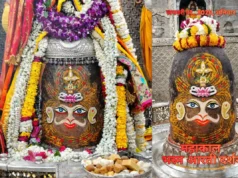
Mahakaleshwar Jyotirlinga is one of the 12 Jyotirlingas, revered shrines of Lord Shiva. It is notably the only Dakshinamukhi (south-facing) lingam in the world, which is considered a unique and powerful aspect of this deity.
- Legend: According to legend, Lord Shiva appeared as Mahakal to destroy a demon named Dushana, who threatened his devotee, King Chandrasena.
- Unique Ritual: Bhasma Aarti: Performed daily at 4 AM, this unique ritual involves offering sacred ash (bhasma) to the deity. This ash traditionally came from funeral pyres, symbolizing detachment and the impermanence of life, though now vibhuti (sacred ash, sometimes made from powdered cow dung) is primarily used. Mahakaleshwar is the only temple in India where this type of aarti is performed.
- Why Visit: It’s believed that darshan (sight) of Mahakal burns away karma and grants spiritual liberation.
- Visiting Tip: For Bhasma Aarti, it is advisable to register online in advance via shrimahakaleshwar.com, or offline a day before at the temple’s Nilkanth Gate. Men are required to wear a traditional dhoti and angavastram, while women must wear a sari or salwar kameez with a dupatta to enter the inner sanctum. Cell phones and cameras are generally not permitted inside the inner sanctum.
2. Kal Bhairav Temple – The Guardian Who Drinks Liquor
- Deity: Kal Bhairav, a fierce manifestation of Shiva, is revered as the guardian (Kotwal) deity of Ujjain, a role assigned by Lord Mahakal himself. The worship of Kal Bhairav was traditionally popular among the Kapalika and Aghora sects, and Ujjain was a prominent center for these traditions.
- Mystery: Liquor is offered as prasad (offering) to the deity, and it mysteriously vanishes from the bowl. Devotees and even scientists have observed that the deity miraculously accepts the liquor, with about one-third often returned as prasad. The exact mechanism of its disappearance remains an unsolved mystery.
- History: The temple’s history is said to date back around 6,000 years, with its origins mentioned in the Avanti Khanda of the Skanda Purana. The present-day temple structure, exhibiting Maratha architectural style, was built over the remains of an older temple, believed to have been constructed by King Bhadrasen. It underwent significant renovations during the Maratha rule.
- Why Visit: Witness unfiltered Shaivite energy—raw, powerful, and protective.
- Significance: According to the Ujjain Government Tourism Portal, the Bhairav circuit, which includes Kal Bhairav Temple, is integral to the city’s sacred layout.
3. Harsiddhi Mata Mandir – The Shaktipeeth of Flames
- Significance: This temple is revered as one of the 51 Shaktipeeths. According to legend, it is believed to be the sacred spot where Devi Sati’s elbow (Kurpara) fell when Lord Vishnu dismembered her body to cease Shiva’s Tandava. Harsiddhi Mata is worshipped as the fearless and powerful Mother Goddess.
- Architecture: The temple complex features two towering Deep Stambhs (lamp towers) that are lit with over 1,000 lamps during Navratri and other festivals, creating a tremendous and divine scene. The current temple also showcases subtle Maratha influences in its design.
- Importance: It is said that King Vikramaditya worshipped Harsiddhi Mata for the protection and prosperity of the city, and the temple was originally built by him.
- Why Visit: Connect with powerful feminine divine energy and experience the beauty of tantric lamps.
4. Chintaman Ganesh – The Worry-Remover
- Deity: The temple is dedicated to Lord Ganesha, specifically as Chintaman Ganesh, meaning “the remover of worries.” Devotees believe that the deity helps alleviate their concerns and grants their wishes.
- History: Chintaman Ganesh Temple is considered the oldest temple in Ujjain, located on the banks of the Shipra River. The idol of Lord Ganesha here is believed to be swayambhu (self-manifested).
- Rituals: This temple is an ideal place for newlyweds, students seeking academic success, and those facing career challenges, who come to seek blessings for a smooth path.
- Architecture: The temple features ancient stone carvings and a rustic sanctum housing the natural idol of Lord Ganesha.
5. Mangalnath Temple – Cosmic Power Center
- Significance: Mangalnath Temple is uniquely known as the birthplace of Mars (Mangal) according to the Matsya Purana and Skanda Purana. It is situated on the northern side of Ujjain along the Shipra River.
- Astronomy & Astrology: The temple’s location is strategically significant, as it is believed to be where the first meridian of India passes, making it an ideal spot for astronomical studies and observations of Mars in ancient times. It is considered a strong spiritual magnetism center and is highly regarded for performing Mangal Dosh Nivaran Puja to mitigate the adverse effects of Mangal Dosha in horoscopes, which is believed to cause obstacles in marriage and other life areas.
- Why Visit: Seek astrological remedies and connect with the cosmic energies of the planet Mars.
6. Sandipani Ashram – Where Krishna Studied
- History: This ancient ashram is revered as the place where Lord Krishna, his elder brother Balarama, and their friend Sudama received their education from Guru Sandipani.
- Features: The ashram contains numerical carvings that are believed to be the ancient script of counting taught by Guru Sandipani. There is also a pond (Gomti Kund) within the premises, which, according to legend, was created by Lord Krishna to provide water for his Guru.
- Saraswati Temple: A rare and spiritually potent Saraswati temple is located inside the ashram, dedicated to the Goddess of knowledge.
- Why Visit: It offers a peaceful environment ideal for meditation and for seekers of Vedic learning, providing a glimpse into the childhood of Lord Krishna.
7. Ram Ghat & Other Minor Shrines
- Ram Ghat: Located on the banks of the Kshipra River, near the Harsiddhi Temple, Ram Ghat is one of the most ancient bathing ghats in Ujjain. It is particularly famous as one of the four sites where the Simhastha Kumbh Mela is held every 12 years. It is believed that a dip in the Kshipra River at Ram Ghat during the Kumbh Mela washes away all sins. The evening Kshipra aarti at Ram Ghat is a significant attraction.
- Other Shrines:
- Siddhavat: Situated on the banks of the Shipra River in Bhairavgarh, Siddhavat is known for an ancient banyan tree believed to have been planted by Goddess Parvati herself. It’s a significant site for performing Pitra Tarpan (ancestral rites) and Kalsarp Dosh Nivaran Puja, and is also one of the sites for the Kumbh Mela.
- Gopal Mandir: Also known as Dwarkadhish Temple, this is the second-largest temple in Ujjain after Mahakaleshwar, dedicated to Lord Krishna. Built in the 19th century by Bayajibai Shinde, wife of Maratha King Daulatrao Scindia, it showcases Maratha architecture. It famously houses silver-plated doors originally from the Somnath Temple, recovered and installed here by Mahadaji Scindia.
- Navagraha Temple: Located at Triveni Ghat on the Shipra River, this temple is dedicated to the nine celestial bodies (Navagrahas) of Hindu astrology. It is believed to have been established by King Vikramaditya over two thousand years ago and is unique as the only Shani temple in India where Lord Shani is worshipped in the form of Lord Shiva. It attracts large crowds on Amavasya (new moon) days, especially those falling on a Saturday (Shani Amavasya).
These shrines collectively form the spiritual grid of Ujjain, offering diverse paths for devotion and spiritual seeking.
From the ash-covered Jyotirlinga to the flame-soaked Shaktipeeth, the temples of Ujjain offer not just architectural beauty but a direct connection to the cosmos. They whisper stories of gods, time, and transcendence—all nestled on the banks of the sacred Shipra River. Ujjain’s spiritual landscape, from the ancient Mahakaleshwar Jyotirlinga to the unique Kal Bhairav Temple and the astrologically significant Mangalnath, truly makes it a timeless spiritual destination. For deeper context on Ujjain’s sacred heritage, refer to Madhya Pradesh Tourism’s official guide to Ujjain, which highlights its temples, festivals, and spiritual traditions.
Frequently Asked Questions
1: How many famous temples are there in Ujjain?
Ujjain has hundreds of temples, but this guide focuses on 7 particularly sacred and important ones, starting from Mahakaleshwar Jyotirlinga, which are considered most significant for pilgrims.
2: Why is Mahakaleshwar temple south-facing?
The Mahakaleshwar Jyotirlinga is uniquely Dakshinamukhi (south-facing). This orientation is considered highly potent and represents Shiva’s destructive energy, symbolizing his control over death (Yama).
3: Can non-Hindus enter Kal Bhairav or Mahakal temple?
Yes, non-Hindus can generally enter both Kal Bhairav and Mahakal temples. However, respectful behavior and strict adherence to temple norms and dress codes are required, especially for rituals like Bhasma Aarti.
4: What is the significance of the Bhasma Aarti?
The Bhasma Aarti at Mahakaleshwar is unique, as it’s the only temple in India where this type of aarti is performed. It represents the impermanence of life and the ultimate reality of death and detachment. The ash signifies the eventual dissolution of the physical body into dust.To learn more about Mahakaleshwar and its special rituals, you can also see Incredible India’s official page on Mahakaleshwar Jyotirlinga.
5: When is the best time to visit Ujjain temples?
Early morning in the winter season (September to February) is generally considered ideal for visiting Ujjain temples due to pleasant weather. It’s advisable to avoid peak Simhastha Kumbh Mela crowds unless you are specifically attending the Kumbh Mela, which is scheduled from March 27 to May 27, 2028.
If you’re walking the spiritual path, Ujjain’s temples are not a stop—they’re a destination.
➡️ Next: Prepare yourself for the grand confluence — Simhastha Kumbh Mela 2028 →