
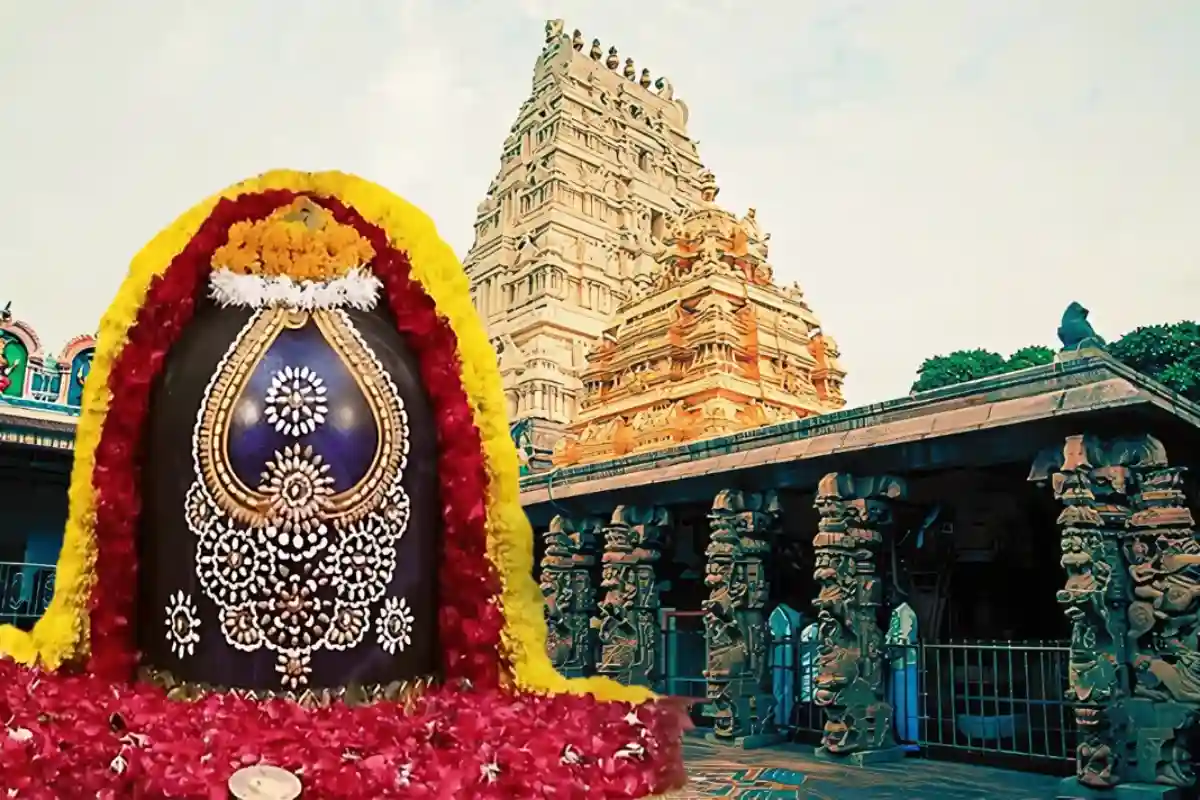

Nestled amidst the tranquil Nallamala Hills of Andhra Pradesh, the Mallikarjuna Jyotirlinga at Srisailam is a unique confluence of devotion and architectural brilliance. This sacred site is dedicated to Lord Shiva and Devi Parvati and is revered as one of the twelve Jyotirlingas of Shiva and one of the fifty-two (or eighteen Maha) Shakti Peethas, centers of the Hindu goddess.
The Mallikarjuna Jyotirlinga holds deep significance to both Shaivism and Shaktism. Here, Lord Shiva is worshipped as Mallikarjuna, represented by a lingam, and his consort Parvati is depicted as Bhramaramba. This article delves into the profound history, religious significance, and captivating architecture of the Mallikarjuna Jyotirlinga, making it one of India’s most important pilgrimage destinations.
Mallikarjuna Jyotirlinga Srisailam: A Dual Pilgrimage Site
The Mallikarjuna Swamy Temple, also known as Srisailam Temple, is a prominent Hindu temple located in Srisailam, Andhra Pradesh. Its distinctive feature lies in the presence of both a Jyotirlinga and a Shakti Peeth within the same complex, a rare occurrence in India. The temple spans two hectares and features four majestic gateway towers called gopurams.
Mallikarjuna Jyotirlinga: Significance and Puranic Legends
The Mallikarjuna Jyotirlinga holds immense religious importance, extensively described in the Shiva Mahapurana. As per Hindu belief, a Jyotirlinga represents Shiva as a fiery column of light, signifying his infinite and boundless nature. The Mallikarjuna Jyotirlinga is the second among the twelve sacred Jyotirlingas in India.
According to one legend, a dispute arose between Lord Brahma and Lord Vishnu regarding the supremacy of creation. To test them, Shiva manifested as an endless pillar of light, asking them to find its ends. Vishnu humbly accepted his defeat, while Brahma falsely claimed to have found the end. Shiva then appeared as a second pillar of light, cursing Brahma that he would not be worshipped in ceremonies, while Vishnu would be venerated eternally. The places where these columns of light are believed to have fallen are where the Jyotirlingas are located.
Another popular legend narrates the story of Lord Shiva and Parvati searching for their son Kartikeya, who had left for Mount Krauncha after Ganesha’s marriage. When Shiva and Parvati arrived to pacify him, Kartikeya tried to move further away, but at the request of the Devas, he remained nearby. The place where Shiva and Parvati stayed became known as Srisailam. It is believed that Lord Shiva appeared as Arjuna on Amavasya (new moon day) and Goddess Parvati as Mallika on Poornima (full moon day), hence the name Mallikarjuna. Another tale suggests that the deity was worshipped with jasmine flowers (locally called ‘Mallika’ in Telugu), contributing to the name Mallikarjuna.
Bhramaramba Shakti Peeth: The Divine Form of the Goddess
Within the Mallikarjuna Jyotirlinga complex lies the shrine of Devi Bhramaramba, revered as one of the fifty-two (or eighteen Maha) Shakti Peethas. It is believed that Sati Devi’s upper lip (or neck, as per some sources) fell here when Lord Shiva carried her lifeless body, transforming it into a Maha Shakti Peetha.
Devi Bhramaramba is an incarnation of Goddess Parvati. According to a legend, a demon named Arunasura, blessed with a boon that no two or four-legged creature could kill him, terrorized the gods. Goddess Durga assumed the form of Bhramari or Bhramarambika, creating thousands of six-legged bees to slay the demon, as his boon did not cover them. The site where this event is believed to have occurred is now worshipped as the Bhramaramba Shakti Peeth. Some devotees believe they can still hear the buzzing of bees from within the temple’s granite walls. The deity is depicted with eight arms and is worshipped as Brahmani Shakti.
Marvelous Architecture and Rich History of Srisailam Temple
The Srisailam Mallikarjuna Jyotirlinga showcases exquisite Dravidian architecture, characterized by its towering gopurams and expansive courtyards. It is considered an excellent example of Vijayanagara architecture. The temple complex, covering two hectares, is enclosed by tall walls measuring 183 m (600 ft) by 152 m (499 ft) and 8.5 m (28 ft) in height. The central mandapam boasts numerous pillars and a colossal idol of Nadikeshwara. The Mukamandapa, leading to the sanctum, features intricately sculpted pillars.
History: Inscriptional evidence from the Satavahana dynasty confirms the temple’s existence from the 2nd century AD. The Nasik inscription of the Satavahana King Vasisthiputra Pulumavi in the 1st century AD also mentions Srisailam Temple. The shrine housing Mallikarjuna is believed to be the oldest part of the temple, dating back to the 7th century. Most modern additions were made during the reign of King Harihara I of the Vijayanagara Empire (14th and 15th centuries).
The veerasheromandapam and paathalaganga steps were constructed during the Vhanni Reddi Kingdom (12th and 13th centuries), whose rulers were devoted to Sri Bhramarambha Mallikarjuna Swamy. The southern, eastern, and western gopurams were constructed by Sri Krishnadevaraya, while Chatrapati Shivaji Maharaj ordered the construction of the northern gopuram in 1677. The temple also houses a Sahasra Linga (1000 lingas), believed to have been commissioned by Lord Rama, and five other lingams by the Pandavas.
The temple is maintained and administered by the government of Andhra Pradesh.
Srisailam Yatra: Darshan and Exploration
A pilgrimage to Srisailam offers not only spiritual solace but also an opportunity to experience its natural beauty. The Krishna River here is known as Patal Ganga, reachable by descending 852 stairs, and its sacred waters are used for bathing the Shiva Linga.
Other Tourist Attractions:
- Shikhareswaram Temple: Located en route to the main temple, it is believed that a darshan here grants freedom from the cycle of rebirth.
- Akkamahadevi Caves: Accessible via a ropeway and boat ride from Patal Ganga.
- Srisailam Dam: One of the largest dams in South India, built across the Krishna River.
- Nagarjunasagar-Srisailam Tiger Reserve: India’s largest tiger reserve, spread across the Nallamala forest ecosystems.
- Sakshi Ganapathi Temple: Another prominent place of worship, considered important to visit before visiting Srisailam.
- Octopus Viewpoint: Offers panoramic views of the Krishna River and the dense jungle.
- Paladhara Panchadara: The spot where Adi Shankara is said to have meditated.
- Hatakeswaram: Another Shiva temple near Paladhara Panchadara.
- Kailasa Dwaram: The main entrance for those trekking to the temple.
Connectivity
- By Air: The nearest airport is Rajiv Gandhi International Airport in Hyderabad (approximately 195-237 km away). Kurnool Airport (181 km) is also a nearby domestic airport.
- By Rail: While there’s no direct rail connectivity to Srisailam, the nearest railway stations are Markapur Road (85 km), Cumbum (60 km), Nandyal (158-160 km), and Kurnool (180-190 km). These stations are connected to major cities like Hyderabad, Delhi, Mumbai, Kolkata, and Chennai.
- By Road: Srisailam is well-connected by road to major cities like Hyderabad (213-230 km), Kurnool (180 km), and Vijayawada (263 km) via buses and taxis. State-run (APSRTC) and private bus services are available.
Accommodation
Srisailam offers various accommodation options, including temple committee cottages and dharamshalas. Some known options include Mallikaarjun Sadan, Ganga Sadan, Gauri Sadan, Punnami Guest House, Sivasadanam, and various private choultries and lodges. Non-AC rooms typically range from ₹500–₹900, while AC rooms are available between ₹1000 and ₹1500.
Best Time to Visit
The ideal time to visit Srisailam is from October to February when the weather is pleasant and conducive for both pilgrimage and sightseeing. Visiting during festivals like Maha Shivaratri and Navaratri offers a unique spiritual experience, despite the larger crowds.
The Mallikarjuna Jyotirlinga in Srisailam stands as a testament to profound faith, rich history, and magnificent architecture. As a sacred abode where Lord Shiva and Devi Parvati are worshipped simultaneously, the Mallikarjuna Jyotirlinga holds a unique and powerful place among India’s pilgrimage sites.
A journey to Srisailam not only offers spiritual peace but also an immersive experience in the natural splendor of the Nallamala Hills.For a broader historical perspective on Jyotirlingas and their cultural legacy, you can explore the detailed entry on Shiva temples in India before planning your spiritual quest.
FAQ Section
1: What is the significance of Mallikarjuna Jyotirlinga Srisailam?
Mallikarjuna Jyotirlinga Srisailam is highly significant as it is one of the twelve Jyotirlingas of Lord Shiva and one of the fifty-two (or eighteen Maha) Shakti Peethas of Goddess Parvati, making it a rare dual pilgrimage site.
2: What is Patal Ganga in Srisailam?
Patal Ganga is the name given to a sacred stretch of the Krishna River at Srisailam, accessible by descending 852 stairs, where devotees take a holy dip and its water is used for the anointing of the Shiva Linga.
3: How old is the Srisailam Temple?
Inscriptional evidence from the Satavahana dynasty indicates the temple’s existence from the 2nd century AD, with the Mallikarjuna shrine considered the oldest part, dating back to the 7th century.Additional scholarly references, such as the Archaeological Survey of India reports, also highlight its continuous cultural and religious importance.
4: What is the architectural style of Mallikarjuna Jyotirlinga?
The Mallikarjuna Jyotirlinga is built in the Dravidian style of architecture, featuring towering gopurams, expansive courtyards, and intricate carvings. It is regarded as a fine example of Vijayanagara architecture.
5: What is the best time to visit Srisailam?
The best time to visit Srisailam is during the winter months, from October to February, when the weather is pleasant and ideal for pilgrimage and exploring the surrounding attractions.
Read on MahakalTimes – Somnath Temple: History, Jyotirlinga Significance & Architecture Guide
For the latest updates on Ancient History, cultural insights, spiritual journeys, and other global events, visit mahakaltimes.com first.