

In the grand, cyclical timeline of Hinduism, the concept of the Dashavatara—the ten primary incarnations of Lord Vishnu—is central to the preservation of Dharma. The word Dashavatara derives from dasa, meaning “ten,” and avatara, roughly equivalent to “incarnation”. Vishnu is said to descend in the form of an avatar to restore cosmic order, eliminate evil, and protect dharma (righteousness).
Nine of these avatars have already appeared. The tenth and final avatar, whose arrival is prophesied to occur at the very end of the current dark age, the Kali Yuga, is known as the Kalki Avatar. The Puranas, including the Srimad Bhagavatam, Vishnu Purana, and the Kalki Purana, provide a detailed and fascinating prophecy of his birth, his divine mission, and his role in resetting the cosmic clock.
When and Why Will Kalki Appear?
The scriptures are clear that Kalki will manifest at the peak of adharma (unrighteousness), at the conjunction of the end of the Kali Yuga and the dawn of the next Satya Yuga. The Kali Yuga, often referred to as the Age of Darkness in Hinduism, is described as a period marked by moral decline and disintegration of the spiritual fabric of society. It is the fourth, shortest, and worst of the four yugas (world ages) in a Yuga cycle. He will appear when:
- Rulers have become nothing more than thieves and corrupt.
- The pursuit of wealth is the only virtue.
- Falsehood, lust, and greed dominate human society.
- The sacred teachings have been forgotten, and religion is practiced only for show.
His primary purpose will be to annihilate the wicked, destroy adharma, protect the righteous, and re-establish the principles of Dharma and Truth to usher in the new Golden Age.
The Prophesied Birth and Form of Kalki
The Puranas give very specific details about Kalki’s birth and appearance.
- Birthplace: He will be born in a village named Shambhala. Shambhala is a Sanskrit word meaning “place of peace” or “place of silence”. While some texts identify it with Sambhal in Uttar Pradesh, India, others suggest it is a mythical or multidimensional kingdom.
- Parentage: He will be born as the son of a noble and virtuous Brahmin named Vishnuyasha and his wife, Sumati. According to Hindu mythology, Vishnuyasha is a reincarnation of Svayambhuva Manu, and Sumati Devi is a reincarnation of Shatarupa.
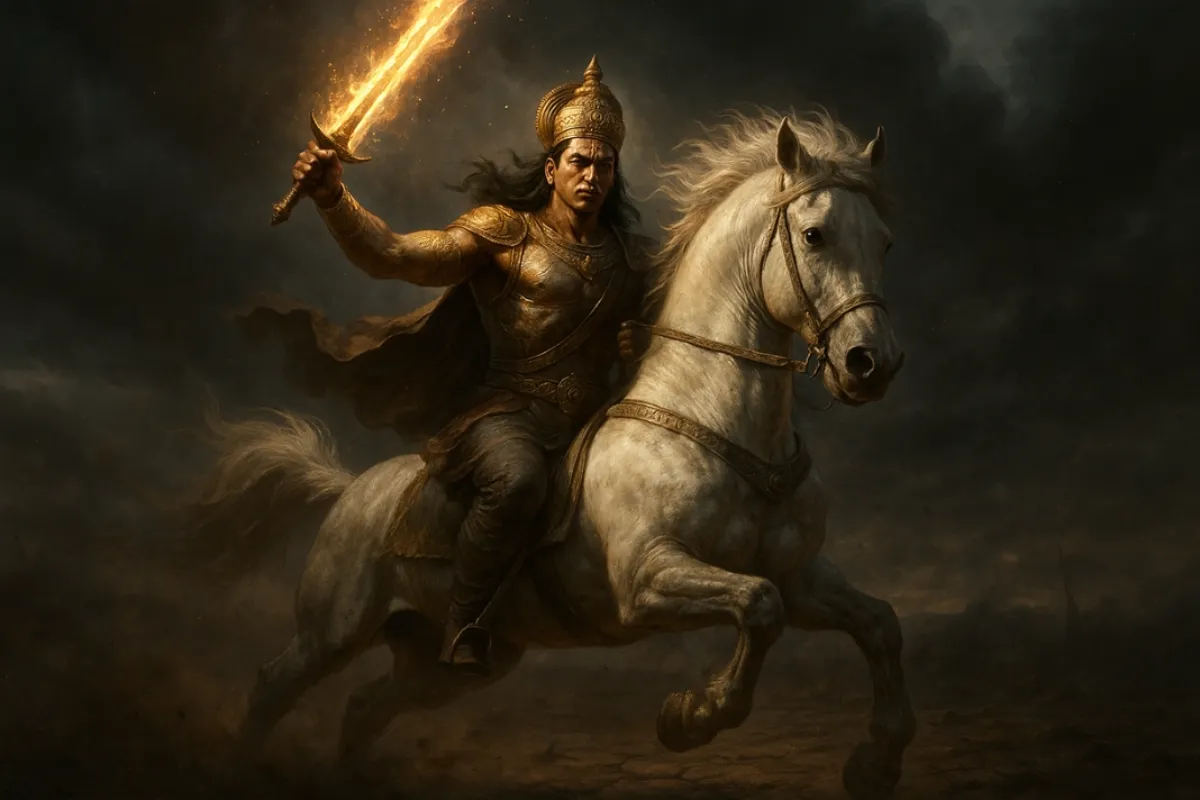
- His Form and Mount: He will be a brilliant and powerful warrior. He will be depicted riding a magnificent, swift white horse named Devadatta. Devadatta is described as a divine, superpowered horse who can “go anywhere at will”. In the Kalki Purana, Devadatta is a manifestation of Garuda, Vishnu’s mount.
- His Divine Weapon: In his hand, he will wield a blazing, divine sword, with which he will destroy the forces of evil. This sword is sometimes referred to as Nandaka or Ratnamaru.
The Divine Mission of Kalki
Upon reaching adulthood and completing his training, Kalki will begin his divine mission.
- Training under Guru Parashurama: The Kalki Purana states that Parashurama, the sixth avatar of Vishnu and one of the Chiranjeevis (Immortals), will be the martial guru of Kalki. He will instruct Kalki to perform a long penance to Shiva to receive celestial weaponry.
- The Annihilation of Adharma: Kalki will travel across the earth on his white horse, and in a great and terrible series of battles, he will vanquish the corrupt rulers, thieves, and all those who promote unrighteousness. His mission is a “cosmic reset,” a necessary and swift surgical cleansing of the world by destroying the wicked “mlecchas” (barbarians).
- The Protection of the Righteous (Sadhus): While he is a force of destruction for the wicked, he will be a savior for the few remaining virtuous and righteous people (sadhus) who have preserved their faith through the darkness of the Kali Yuga. He will gather them and ensure their survival, establishing moral law in the form of the four-fold varnas.
- The Dawn of the New Satya Yuga: After completely ridding the earth of evil, Kalki will perform a great Ashwamedha Yajna (horse sacrifice), signifying his righteous rule. The Ashwamedha Yajna was an ancient Vedic horse sacrifice ritual used by powerful victorious kings to prove their imperial sovereignty and ensure general prosperity of the kingdom. He will then renounce his warrior form and ascend to Vaikuntha, and the new Satya Yuga, the Age of Truth, will begin. The Satya Yuga is the first and best of the four yugas in a Yuga cycle, often called the “Golden Age,” characterized by knowledge, meditation, penance, and complete peace on Earth. The minds of all remaining people will be awakened, and a new era of peace, purity, and spirituality will dawn upon the world.
The Kalki Avatar prophecy stands as a powerful testament to the cyclical nature of time and the eternal promise of Dharma’s restoration in Hinduism. As the final incarnation of Lord Vishnu, Kalki’s arrival at the darkest hour of the Kali Yuga signifies a cosmic reset—a necessary cleansing to pave the way for a new Golden Age.
From his prophesied birth in Shambhala to his divine mission of vanquishing evil upon his white horse Devadatta, the legend of Kalki inspires hope, reminding devotees that even in times of profound unrighteousness, divine justice will ultimately prevail, ushering in an era of peace, purity, and spiritual awakening. For a broader perspective on how cyclical time is understood in Hindu philosophy, readers can explore the detailed overview on Hindu cosmology at Britannica.
Frequently Asked Questions about Hindu Prophecies
1: Is the Bhavishya Purana considered an authentic scripture?
The Bhavishya Purana is a complex case. While it is one of the 18 Mahapuranas, scholars believe it is a “living text” that has been edited and added to over many centuries. Its core may be ancient, but many of its most specific “prophecies” are considered by experts to have been written after the events occurred. It’s best read with a discerning, not a literal, mindset, as it exists in many inconsistent versions.
2: Who is Kalki Avatar?
Kalki is the prophesied tenth and final avatar of Lord Vishnu. He is foretold to appear at the end of the current dark age, the Kali Yuga. His divine mission will be to destroy the rampant evil and unrighteousness in the world and to usher in the next Satya Yuga (Golden Age), re-establishing Dharma.
3: Are the predictions for the Kali Yuga meant to be taken literally?
The predictions for the Kali Yuga, found in texts like the Srimad Bhagavatam and Vishnu Purana, describe general trends of moral, social, and spiritual decline. While some descriptions can seem literally true in our modern world (like corrupt rulers or environmental distress), they are best understood as outlining the primary spiritual challenges of this particular age. The Kali Yuga is characterized by conflict, sin, and a decline in virtues.
4: Do the Puranas predict a final “end of the world”?
No, not in the apocalyptic sense. Hindu cosmology is cyclical. The end of the Kali Yuga is not the end of the world, but simply the end of a dark phase. It will be followed by a transition into a new, pristine Satya Yuga. The Kali Yuga is estimated to last 432,000 years. The ultimate end, the Maha-Pralaya (Great Dissolution), is a complete cosmic overhaul where the entire universe is dissolved back into its primordial state, but this occurs on a much grander timescale (311.04 trillion human years) at the end of Brahma’s life, after which creation begins anew.
5: What is the main difference between Vishnu’s role and Shiva’s role in the future?
Lord Vishnu’s role is to preserve Dharma within the timeline of the Yugas, which he does through his avatars like Kalki. Lord Shiva’s role as Mahakal is ultimate and absolute; he presides over the dissolution of the entire cosmic timeline itself during the Maha-Pralaya, dissolving everything back into his own timeless consciousness. Pralaya, or dissolution, represents a cosmic reset, marking the end of a cycle and the prelude to renewal, overseen by Shiva
To deepen your understanding of these fundamental principles, explore our comprehensive article on [The Shiva Tattva Explained]. Unravel more spiritual wisdom and connect with the timeless truths.