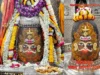



Grishneshwar Jyotirlinga is a revered Hindu temple dedicated to Lord Shiva, located in Verul village of Aurangabad district, Maharashtra, India. Recognized as one of the 12 sacred Jyotirlinga mandirs, the Grishneshwar Jyotirlinga holds immense religious and historical significance. The mandir is a nationally protected site, situated just one and a half kilometers from the world-famous Ellora Caves, approximately 30 kilometres (19 miles) north-west of the city of Aurangabad, and about 300 kilometres (190 miles) east-northeast from Mumbai.
This ancient shrine, often referred to as Grushneshwar or Ghrishneshwara, is mentioned in revered Hindu scriptures such as the Shiva Purana, the Skanda Purana, the Ramayana, and the Mahabharata. The name “Ghrneshwara” translates to “Lord of Compassion,” symbolizing the temple’s deep spiritual essence. This pilgrimage site, the divine Grishneshwar Jyotirlinga at Verul, continues to attract devotees seeking blessings and a profound connection with the compassionate aspect of Lord Shiva.
Location and Significance
- Geographic Details: Grishneshwar Jyotirlinga is a Hindu temple of Shiva in Verul village of Aurangabad district, Maharashtra, India. It is located in Aurangabad District.
- Proximity to Ellora Caves: The temple is a national protected site, one and a half kilometers away from the Ellora Caves, a UNESCO World Heritage Site.
- Distance from Major Cities: It is situated 30 kilometres (19 miles) north-west of the city Aurangabad, and 300 kilometres (190 miles) east-northeast far from Mumbai.
- Status as a National Protected Site: The temple has been designated as a national protected site.
- Mentions in Ancient Scriptures: Grushneshwar is mentioned in the Shiva Purana, the Skanda Purana, the Ramayana, and the Mahabharata.
- Meaning of “Ghrneshwara”: The word Ghrneshwara means “lord of compassion”.
The Legend of Ghushma and the Earthly Shivlingas
This poignant story from the Puranas explains the manifestation of the Grishneshwar Jyotirlinga.
- Sudharma and Sudeha: A Childless Brahmin Couple: In the south country, near the Devgiri Mountain, there lived a very bright ascetic Brahmin named Sudharma. His wife’s name was Sudeha. Both of them had a lot of love for each other, but they had no children. Astrological calculations showed that there could be no childbirth from Sudeha’s womb.
- Sudeha’s Suggestion: Marrying her Younger Sister Ghushma: Sudeha was very keen to have children and urged Sudharma to marry her younger sister. At first, Sudharma did not want to do this, but in the end, he had to bow down to his wife’s insistence. He married his wife’s younger sister Ghushma and brought her home.
- Ghushma’s Devotion: Worshipping 101 Earthly Shivalingas Daily: Ghushma was a very humble and virtuous woman. She was an ardent devotee of Shiva. Every day, she made one hundred and one earthly Shivalingas and worshipped them with true devotion.
- Birth of Ghushma’s Son: Shiva caused a very beautiful and healthy child to be born from her womb a few days later. With the birth of the child, there was no end to the joy of both Sudeha and Ghushma. Their days were going by very comfortably.
- Sudeha’s Jealousy and Heinous Act: A while later, a bad thought took birth in Sudeha’s mind. She thought, “I don’t have anything in this house. Everything here has been infiltrated. She also took control of my husband. The child is also hers.” This evil thought slowly began to grow in her mind. Meanwhile, the child of Ghushma was also growing up and slowly became young and got married. Finally, one day, Sudeha killed Ghushma’s young son while sleeping at night. She took his body and threw it in the same pond in which Ghushma used to immerse the earthly Shivalingas every day.
- Ghushma’s Unwavering Faith and Shiva’s Appearance: In the morning, everyone came to know about it. There was chaos in the whole house. Both Sudharma and his daughter-in-law beat their heads and started crying bitterly. But Ghushma remained engrossed in the worship of Shiva as usual as if nothing had happened. After finishing the puja, she set out to release the mortal Shivalingas into the pond. When she started returning from the pond, her beloved son was seen coming out from inside the pond. He fell at the feet of Ghushma. As if he was somewhere nearby at the same time, Shiva also appeared there. He was very angry with Sudeha’s heinous act. He was eager to slit her throat with his trident.
- Ghushma’s Plea for Forgiveness and Shiva’s Blessing: Ghushma folded her hands and said to Shiva, “Prabhu! If you are happy with me, forgive that unfortunate sister of mine. She has committed a heinous sin, but by Your mercy I got my son back. Now forgive her my lord! I have one more prayer, for the welfare of the people, you should live in this place forever.” Shiva accepted both these things. Appearing in the form of Jyotirlinga, he started living there. Due to the worship of Sati Shiva devotee Ghushma, he became known here as Ghushmeshwar Mahadev.
Jyotirlinga Origin: Brahma-Vishnu Supremacy Debate
- Shiva Purana: Brahma-Vishnu Argument: According to the Shiv Mahapuraan, once Brahma (the Hindu God of creation) and Vishnu (the Hindu God of preservation) had an argument in terms of supremacy of creation. To test them, Shiva pierced the three worlds as a huge endless pillar of light, the Jyotirlinga. Vishnu and Brahma split their way downwards and upwards respectively to find the end of the light in either direction. Brahma lied that he found out the end, while Vishnu conceded his defeat. Shiva appeared as the second pillar of light and cursed Brahma, that he would have no place in ceremonies while Vishnu would be worshipped until the end of eternity.
- Jyotirlinga as Supreme Partless Reality: The jyotirlinga is the supreme partless reality, out of which Shiva partly appears. The jyotirlinga shrines, thus, are places where Shiva appeared as a fiery column of light. Originally there were believed to be 64 jyotirlingas, while 12 of them are considered to be very auspicious and holy. Each of the twelve jyotirlinga sites takes the name of the presiding deity – each considered a different manifestation of Shiva. At all these sites, the primary image is lingam representing the beginningless and endless Stambha pillar, symbolizing the infinite nature of Shiva.
- The Twelve Jyotirlingas: The twelve jyothirlinga are Somnath at Veraval in Gujarat, Mallikarjuna at Srisailam in Andhra Pradesh, Mahakaleswar at Ujjain in Madhya Pradesh, Omkareshwar in Madhya Pradesh, Kedarnath in Himalayas, Bhimashankar in Maharashtra, Viswanath at Varanasi in Uttar Pradesh, Triambakeshwar in Maharashtra, Vaidyanath at Deoghar in Jharkhand, Nageswar at Dwarka in Gujarat, Rameshwar at Rameswaram in Tamil Nadu and Grishneshwar at Aurangabad in Maharashtra.
Temple Architecture and Historical Resilience
- Architectural Style: The Grushneshwar Jyotirlinga Mandir is built with black stone on an area spanning 44,000 sq ft. It has various sculptures and fine designs on its interior and exterior walls. The temple is built in the Hemadpanthi style. The Garbhgruh and Antarala are constructed using indigenous stone in the Indo-Aryan architectural style. The pillars and door frames of the temple are covered with intricate carvings of deities and human figures. A Jyotirlinga murti is situated in the Garbhgruh of the mandir, and a large murti of Lord Shiva’s favourite Bhakt Nandi is present in front of the main door.
- History of Destruction and Rebuilding: The temple structure was destroyed by the Delhi Sultanate in the 13th and 14th centuries. The temple went through several rounds of rebuilding followed by re-destruction during the Mughal-Maratha conflict. Maloji Bhosale (grandfather of Shivaji) first restored it in the 16th century. It was rebuilt to its current form in the year 1729, under the sponsorship of Queen Gautama Bai Holkar of Indore, after the fall of the Mughal Empire.
Pilgrimage Experience and Temple Customs
- Active Pilgrimage Site: It is presently an important and active pilgrimage site of the Hindus and attracts long lines of devotees daily.
- Entry to Sanctum Sanctorum: Any pilgrim can enter the temple premises and its inner chambers, but to enter the sanctum sanctorum (garbha-gruha) of the temple, the local Hindu tradition demands that men must go bare-chested. Women are allowed into the sanctum, but must be dressed in a saree.
- Why Visit: Pilgrims visit to connect with the “Lord of Compassion” and experience Shiva’s grace, as exemplified in Ghushma’s legend.
Other Jyotirlingas in Maharashtra
The Grishneshwar Jyotirlinga is one of the five Jyotirlingas of Maharashtra. The other four Jyotirlingas in Maharashtra are:
- Trimbakeshwar Shiva Temple
- Bhimashankar Temple
- Shri Vaijnath Temple
- Aundha Nagnath Temple
Grishneshwar Jyotirlinga stands as a sacred beacon of India’s spiritual heritage, devotion, and resilience. As the final Jyotirlinga among the twelve sacred shrines, Grishneshwar Jyotirlinga completes the circle of divine energy associated with Lord Shiva. Its quiet power lies not in grandeur but in the timeless stories carved into its stones, the legends passed down through generations, and the unwavering devotion of its pilgrims.
From its origins rooted in the miraculous legend of Ghushma to its architectural resilience through centuries of destruction and rebuilding, the Grishneshwar Jyotirlinga Temple offers a deeply fulfilling experience for pilgrims and travelers alike. It truly is a place where the spiritual meets the eternal, offering blessings for prosperity, health, and liberation a sacred site also recognized within UNESCO’s list of World Heritage Sites for its proximity to the Ellora Caves.”
Frequently Asked Questions
1: What is the legend of Ghushma related to Grishneshwar Temple?
The legend of Ghushma tells the story of a devout woman, Ghushma, who worshipped 101 earthly Shivlingas daily. Her son was tragically killed by her jealous sister, Sudeha, but due to Ghushma’s unwavering faith, Lord Shiva appeared, resurrected her son, and agreed to reside at the spot as Ghushmeshwar Mahadev, the Lord of Compassion.
2: Why is Grishneshwar Temple also called Ghushmeshwar?
Grishneshwar Temple is also called Ghushmeshwar Mahadev because, according to the legend, Lord Shiva, pleased by the unwavering devotion and prayer of his devotee Ghushma, agreed to reside permanently at that location in the form of a Jyotirlinga. The name Ghushmeshwar is thus derived directly from her name.
3: What is the dress code for entering the sanctum sanctorum?
For men, the local Hindu tradition demands that they must go bare-chested to enter the sanctum sanctorum (garbha-gruha) of the temple. Women are allowed to enter, but are required to wear a saree.
4: What is the significance of Grishneshwar being near Ellora Caves?
Grishneshwar Temple’s proximity to the Ellora Caves, a UNESCO World Heritage Site famous for its rock-cut cave temples and monasteries, enhances its cultural and historical significance. Pilgrims often combine a visit to the Jyotirlinga with an exploration of the ancient carvings and architectural wonders of Ellora, according to detailed archaeological documentation by the Archaeological Survey of India.”
5: Who rebuilt the current Grishneshwar Temple?
The current Grishneshwar Temple was largely rebuilt to its present form in 1729 under the sponsorship of Queen Gautama Bai Holkar of Indore, after facing multiple destructions by the Delhi Sultanate and during the Mughal-Maratha conflicts. Maloji Bhosale had also undertaken its restoration in the 16th century.
For further exploration of Maharashtra’s spiritual treasures, delve into other Jyotirlingas in Maharashtra like Trimbakeshwar Shiva Temple and Bhimashankar Temple. Explore the architectural wonders of the region with a guide to the Ellora Caves.
For the latest updates on Ancient History, cultural insights, spiritual journeys, and other global events, visit mahakaltimes.com first.