


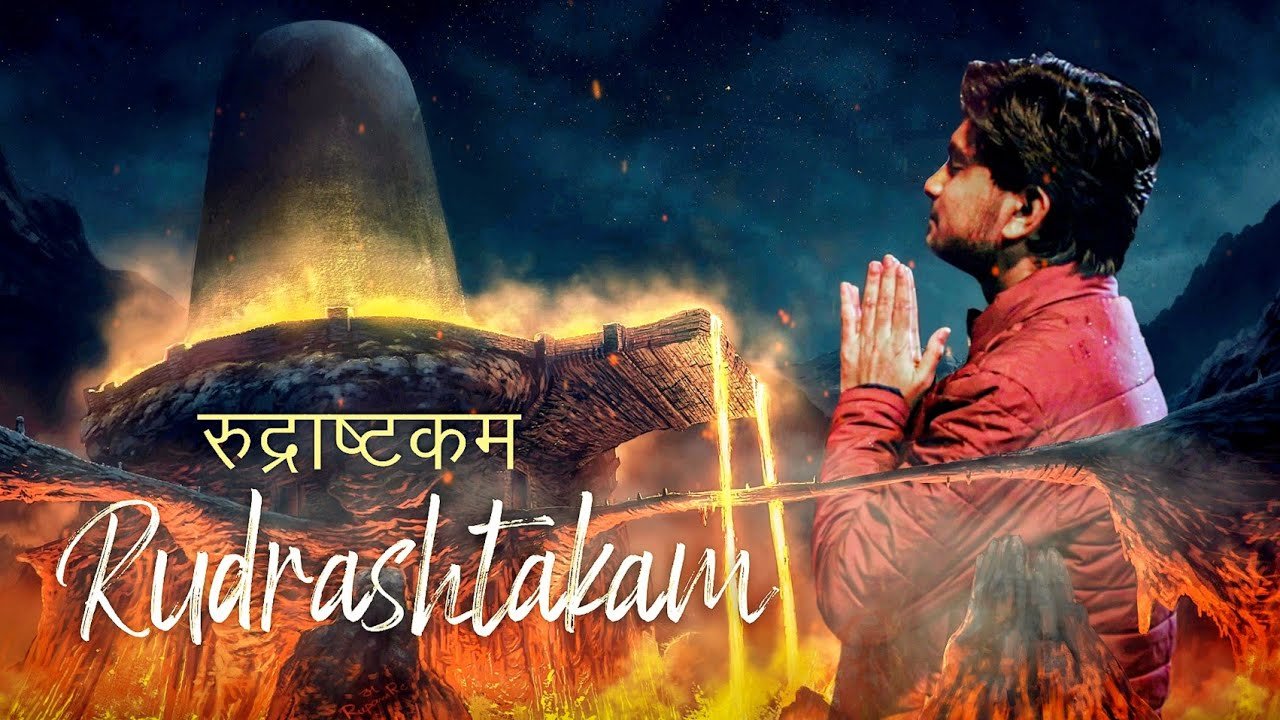
Rudrashtakam is a revered Sanskrit hymn dedicated to Lord Shiva, composed by Goswami Tulsidas. This powerful composition, known for its deep spiritual resonance, holds a special place in Shaivite traditions. Goswami Tulsidas, a Hindu Vaishnava saint and poet, renowned for his devotion to Lord Rama, lived in the 16th century CE and is most famous for his epic poem Ramcharitmanas.
The Rudrashtakam stotra praises the different forms and attributes of Lord Shiva, invoking his blessings and protection. The term “Rudrashtakam,” literally meaning “eight stanzas to Rudra,” symbolizes a complete offering of devotion through eight verses that glorify Shiva’s infinite qualities.
Among Shiva’s devotees, the Rudrashtakam remains one of the most popular and frequently recited hymns. This sacred stotram (hymn of praise), rendered beautifully by Sounds of Isha and other devotional groups, continues to inspire seekers toward inner peace and divine connection. This guide will delve into the profound meaning of each verse and the spiritual benefits of chanting this sacred hymn.
What is Rudrashtakam?
The Rudrashtakam is an octet, or a hymn of eight stanzas, that expresses deep devotion and reverence for Lord Shiva. It is a powerful prayer that invokes Shiva’s various aspects, from the peaceful and benevolent to the fierce and destructive, all while highlighting his ultimate nature as the supreme consciousness. The hymn beautifully describes Shiva’s form, his cosmic attributes, and his role as the benefactor of all beings. It is often chanted by devotees seeking solace, protection, and spiritual upliftment. Rudrashtakam is a combination of two words: ‘Rudra’ and ‘Ashtakam’. Rudra stands for a manifestation of Lord Shiva.
- Meaning of Rudrashtakam : The Rudrashtakam conveys complete surrender to Lord Shiva, portraying him as the supreme reality beyond birth, death, form, and attributes. It praises his calm yet powerful nature — the one who dissolves ignorance, protects righteousness, and sustains the rhythm of the universe. The hymn expresses the devotee’s deep yearning to experience the divine presence of Rudra, who embodies both destruction and compassion. Every line echoes humility and the realization that ultimate peace is found only in Shiva’s grace.
- Overall Meaning : At its core, the Rudrashtakam is a meditation on the timeless truth that all creation emerges from and dissolves into Shiva. Through its poetic verses, it reveals the oneness of the soul with the supreme consciousness, teaching that liberation (moksha) is achieved not through ritual or wealth, but through faith, devotion, and inner purity. Reciting the Rudrashtakam is believed to remove fear, calm the mind, and connect the devotee with the infinite power of Lord Shiva — the eternal Rudra who dwells within all beings.
Rudrashtakam Sanskrit Text (Original Verses)
Here is the complete text of the Rudrashtakam:
Namāmiśamīśāna nirvāṇa rūpaṁ
vibhuṁ vyāpakaṁ brahma-veda-svarūpam ।
nijam nirguṇaṁ nirvikalpaṁ nirīhaṁ
cidākāra mākaśa vāsaṁ bhaje’ham ॥ 1 ॥
Nirākāra monkaṁ manasā veda rūpaṁ
nirañjaṁ niraṃśaṁ nirādhāra mīḍyam ।
mahādevaṁ īśaṁ mahābhūta saṅghaṁ
mahākāla kālaṁ bhaje’ham bhaje’ham ॥ 2 ॥
Śivam śānta rūpaṁ manohāri dehaṁ
vicitraṁ vapur veda rūpaṁ vibhum tvam ।
parātīta tattvaṁ prasannaṁ prapañcaṁ
paraṁ paavanaṁ pāvanaṁ tvāṁ namāmi ॥ 3 ॥
Namāmiśamīśaṁ bhavābhāva heṭuṁ
namāmi prapannaṁ prapañca sthitāram ।
namāmi śivānaṁ śivānanda rūpaṁ
namāmi śivaṁ śivam eva prapadye ॥ 4 ॥
Na yatra prapañco na māyā na kālaḥ
na yatra prapañco na vedā na tattvam ।
na yatra prapañco na yogo na dharmo
tamekaṁ paraṁ śāśvataṁ śānta rūpam ॥ 5 ॥
Na bhaktiṁ vinā te bhavaṁ nāma nātha
na muktir na śāntiḥ śivābhāva nānyat ।
tamekaṁ mahādeva devaṁ śaraṇyaṁ
bhaje’ham bhaje’ham bhaje śaṅkara tvām ॥ 6 ॥
Yataḥ sarva bhūtāni bhavanti svabhāvāt
yataḥ sarva bhūtāni yanti svabhāvāt ।
tad ekaṁ paraṁ brahma rūpaṁ bhaje’ham
namāmiśvaram sarva kāraṇa kāraṇam ॥ 7 ॥
Na jānaṁ na jāne na jāne tvadanyaṁ
na jāne na jāne na jāne tvadanyaṁ ।
na jāne na jāne śivaṁ kevalaṁ tvāṁ
bhaje’ham bhaje’ham bhaje śaṅkara tvām ॥ 8 ॥
Rudrashtakam: Verse-by-Verse Meaning and Significance
Each verse of the Rudrashtakam paints a vivid picture of Lord Shiva’s divine qualities and forms.
1. Verse 1
Namāmiśamīśāna nirvāṇa rūpaṁ vibhuṁ vyāpakaṁ brahma-veda-svarūpam ।
nijam nirguṇaṁ nirvikalpaṁ nirīhaṁ cidākāra mākaśa vāsaṁ bhaje’ham ॥ 1 ॥
- Meaning: I bow to Ishana, the supreme Lord, whose very essence is ultimate liberation. He is the all-pervading and expansive reality, the embodiment of Brahman and the wisdom of the Vedas. My worship is directed towards that self-existent being who is beyond all manifest qualities (Nirguna), free from all conceptual frameworks, devoid of worldly desires, a vast expanse of pure consciousness, dwelling in the cosmic ether.
- Significance: This verse establishes Shiva as the ultimate, formless reality, the source of all knowledge and liberation. It emphasizes his transcendent nature, existing beyond the limitations of human perception and material attributes, yet he is the all-encompassing consciousness. This verse sets the tone for the entire hymn
2. Verse 2
Nirākāra monkaṁ manasā veda rūpaṁ nirañjaṁ niraṃśaṁ nirādhāra mīḍyam ।
mahādevaṁ īśaṁ mahābhūta saṅghaṁ mahākāla kālaṁ bhaje’ham bhaje’ham ॥ 2 ॥
- Meaning: My reverence is to the Lord who is formless, the primal source of the sacred syllable Om, existing in the transcendent fourth state (Turiya). He is beyond the grasp of speech, intellect, and senses, the majestic lord of the mountains (Girisha). This terrifying yet supremely compassionate being is the very devourer of Mahakala (Great Time). He is the repository of all virtues and the one who guides us across the ocean of samsara (the cycle of birth and death).
- Significance: This verse highlights Shiva’s role as the cosmic origin, linked to the primordial sound Om. It portrays him as the master of time and destruction (Mahakalakala), yet simultaneously compassionate, offering liberation from the cycle of existence. His dual nature as both fierce and benevolent is beautifully captured. This verse invites contemplation of Shiva beyond conventional understanding.
3. Verse 3
Śivam śānta rūpaṁ manohāri dehaṁ vicitraṁ vapur veda rūpaṁ vibhum tvam ।
parātīta tattvaṁ prasannaṁ prapañcaṁ paraṁ paavanaṁ pāvanaṁ tvāṁ namāmi ॥ 3 ॥
- Meaning: I worship the Lord who is as radiant and fair as the snow-clad Himalayas, and whose presence is profoundly deep and unfathomable. His divine body emanates a splendor comparable to millions of Kamadevas (gods of love). From his magnificent matted locks flows the pure and captivating river Ganga, while the youthful crescent moon graces his forehead. Around his neck, serpents coil gracefully like ornaments.
- Significance: This verse offers a vivid visualization of Shiva’s iconic physical form, blending majestic beauty with ascetic symbols. The Ganga, crescent moon, and snakes are all powerful representations of his control over nature, creation, destruction, and his unique divine identity. His radiance is compared to the pristine snow of the Himalayas.
4. Verse 4
Namāmiśamīśaṁ bhavābhāva heṭuṁ namāmi prapannaṁ prapañca sthitāram ।
namāmi śivānaṁ śivānanda rūpaṁ namāmi śivaṁ śivam eva prapadye ॥ 4 ॥
- Meaning: I meditate upon the Lord who is adorned with swaying earrings, and whose brow is subtly arched, reflecting profound contemplation or a gesture of divine grace. He is the meditative presence from whom all blessings flow. Bearing the emblem of a bull on his banner, he is the formless controller of the universe (Kshetri-shunya) who is easily swayed by sincere devotion. My worship is dedicated to this Ishvara, who is captivated by the essence of pure devotion. His smiling face, large, beautiful eyes, and serene blue throat are celebrated, and he is described as warm-hearted and compassionate.
- Significance: This verse delves into Shiva’s posture of meditation and his responsiveness to devotion. His divine presence is described as granting boons and residing in the hearts of his devotees, emphasizing that despite his cosmic power, he is accessible through pure bhakti. The bull (Nandi) symbolizes righteousness and his vehicle. This imagery reflects his acceptance of all aspects of existence.
5. Verse 5
Na yatra prapañco na māyā na kālaḥ na yatra prapañco na vedā na tattvam ।
na yatra prapañco na yogo na dharmo tamekaṁ paraṁ śāśvataṁ śānta rūpam ॥ 5 ॥
- Meaning: My salutations are to Sharva, the unique and eternal Lord, who is perpetually liberated through deep meditation. He has cast aside all personal wealth and commercial activities, establishing himself firmly in the posture of profound Samadhi. He is supremely great, existing eternally in the highest state of detachment, the one true reality, perpetually immersed in divine consciousness. He is an illustrious devotee of Devi Bhavani, who is fierce, immense, mature and brave, beyond all, indivisible, unborn, and resplendent like millions of sun. He uproots the three negative qualities (tamas, rajas, and sattva), and holds a trident.
- Significance: This verse emphasizes Shiva’s role as the supreme ascetic and yogi. It highlights the ideal of renunciation and deep meditative absorption (Samadhi) as a path to liberation, with Shiva himself as the ultimate embodiment of this detached and eternally blissful state. His trident symbolizes his power to liberate devotees from worldly attachments.
6. Verse 6
Na bhaktiṁ vinā te bhavaṁ nāma nātha na muktir na śāntiḥ śivābhāva nānyat ।
tamekaṁ mahādeva devaṁ śaraṇyaṁ bhaje’ham bhaje’ham bhaje śaṅkara tvām ॥ 6 ॥
- Meaning: I bow to Shankara (Shiva), the pure, eternal being, who is honored by all. He is adorned with teeth that shine like gold and is bathed in the sacred current of pure, sweet milk. Adorned with luminous earrings, he is the fundamental cause of all existence, the supreme Lord of all beings. He is also extolled as Dhananjaya, the conqueror of wealth or Arjuna. He is the one who transcends time itself, bringing auspiciousness and marking the end of cosmic cycles. He grants ultimate bliss, dispels illusions, and conquers desires, freeing us from the cycle of birth and death.
- Significance: This verse brings forth Shiva’s purity and his role as the fundamental source. It combines the imagery of his physical adornments with his status as the Lord of all creation, highlighting his benevolence and his acceptance of various forms of worship. He is the destroyer of Mahmaya (illusions) and provides pleasure to wise human beings.
7. Verse 7
Yataḥ sarva bhūtāni bhavanti svabhāvāt yataḥ sarva bhūtāni yanti svabhāvāt ।
tad ekaṁ paraṁ brahma rūpaṁ bhaje’ham namāmiśvaram sarva kāraṇa kāraṇam ॥ 7 ॥
- Meaning: I worship the highly renowned Vaidyanath, the Lord of Physicians, who is profoundly dear to his devotees and fulfills their aspirations. He is an boundless ocean of compassion and the root source of eternal bliss. My adoration is for Neelkantha (the blue-throated one), who consumed the Halahala poison to protect the world, the supreme Lord, and the sole sovereign of the universe, ever ready to shower his grace. It is believed that until the lotus feet of Shiva, the beloved of Uma, are worshipped, humans will not find peace, prosperity, or freedom from sorrow.
- Significance: This verse focuses on Shiva’s compassionate and healing aspects, particularly as Vaidyanath, the ultimate healer. His act as Neelkantha, consuming poison for cosmic welfare, exemplifies his boundless mercy and self-sacrifice, making him a beloved deity who is a source of immense joy and grace.
8. Verse 8
Na jānaṁ na jāne na jāne tvadanyaṁ na jāne na jāne na jāne tvadanyaṁ ।
na jāne na jāne śivaṁ kevalaṁ tvāṁ bhaje’ham bhaje’ham bhaje śaṅkara tvām ॥ 8 ॥
- Meaning: My worship is for the Lord who permeates the entire universe, who is revered by all beings and celestial gods, and who manifests as the ultimate Brahman in the form of the Lingam. I adore Shambhu, the majestic Lord of the mountains (Girisha), who is eternally benevolent and the singular master of all realms. He is the one who, in some iconographies, appears with five faces (Panchavaktram) and is universally adored as the supreme Lord. The eighth verse conveys the simplicity of devotion, stating that a heartfelt prayer to Shambhu can protect us from the pains of old age, birth, and suffering.
- Significance: The final verse encapsulates Shiva’s universal omnipresence and his status as the supreme deity. It emphasizes his worship in the form of the Lingam, representing the infinite Brahman, and his role as the benevolent Lord of all worlds, accessible through devotion and embodying the cosmic five-fold functions (Panchavaktram).
Benefits of Chanting Rudrashtakam
The Rudrashtakam is a powerful hymn that bestows numerous blessings upon its devotees. Reciting the Rudrashtakam is believed to:
- Attain Divine Grace: The primary benefit is receiving the divine grace and blessings of Lord Shiva. The hymn concludes with the statement, “Thus ends the Rudrashtakam, composed by Goswami Tulsidas. Reciting the Rudrashtakam is believed to bring peace, remove obstacles, and grant the blessings of Lord Shiva”.
- Overcome Adversity: Chanting the hymn is believed to dispel all sorrows, troubles, and fears, including the fear of death, and effectively overcome life’s obstacles. It helps in removing negativity from life.
- Promote Inner Peace: The sacred vibrations generated through its recitation promote mental tranquility, alleviate stress, and cultivate a deep sense of inner peace and calmness. Regular recitation can help one become more focused.
- Purify the Spirit: Regular chanting contributes to the purification of the mind and soul, fostering spiritual growth and clear understanding. It helps to cleanse the aura of a person.
- Fulfill Righteous Desires: Devotees believe that chanting with sincere devotion can help in the fulfillment of their righteous wishes and aspirations.
- Enhance Devotion: The hymn serves to strengthen one’s connection with Lord Shiva, thereby enhancing faith and profound devotion. It helps to control a disturbed mind and drive away disturbing thoughts.
- Health and Prosperity: Chanting daily can help get rid of diseases and promotes overall health and happiness. It can also reduce the ill effects of astrological problems, or Graha dosha.
The Rudrashtakam, a timeless creation of Goswami Tulsidas, serves as a profound expression of devotion to Lord Shiva. Composed in Sanskrit, the Rudrashtakam stotra consists of eight powerful verses that beautifully encapsulate the essence of Shiva’s divine nature—his majestic form, his supreme control over cosmic forces, and his boundless compassion for his devotees. Chanting the Rudrashtakam is not merely an act of recitation but a meditative journey that purifies the soul, alleviates suffering, and strengthens one’s connection with the ultimate reality. Through this sacred hymn, devotees can immerse themselves in the glory of Mahadev and experience his protective grace, leading towards inner peace and spiritual liberation.
Frequently Asked Questions
1: Who composed the Rudrashtakam?
The Rudrashtakam, a revered Sanskrit hymn dedicated to Lord Shiva, was composed by Goswami Tulsidas, the famous 16th-century Hindu saint and poet best known for his Ramcharitmanas. Tulsidas was a Vaishnava (Ramanandi) Hindu saint, born in Rajpur, Uttar Pradesh. He spent most of his life in Banaras (modern Varanasi) and Ayodhya.
2: What does “Rudrashtakam” literally mean?
“Rudrashtakam” literally means “octet to Rudra” or “eight stanzas to Rudra,” referring to the eight verses of the hymn dedicated to Lord Shiva in his Rudra aspect. An Ashtakam is a form of sacred poetry or hymn which has eight parts or verses.
3: What is the main purpose of chanting Rudrashtakam?
The main purpose of chanting Rudrashtakam is to praise and glorify Lord Shiva’s various forms and attributes, invoke his blessings and protection, seek liberation from the cycle of birth and death, and promote inner peace and spiritual upliftment. It helps in the removal of sorrows and sufferings.
4: Which specific forms or attributes of Shiva are highlighted in the Rudrashtakam?
The Rudrashtakam highlights Shiva’s diverse attributes including his formless and supreme nature, his role as Mahakalakala (destroyer of time), his benevolent form adorned with Ganga and crescent moon, his association with Nandi, and his compassion as Vaidyanath (Lord of Physicians) and Neelkantha (blue-throated one). He is also described as the destroyer of Tripurasuras.
5: Is there any particular occasion when Rudrashtakam is especially chanted?
While Rudrashtakam can be chanted any time with devotion, specific days like Mondays (dedicated to Lord Shiva) and Mahashivratri are considered highly auspicious for its recitation. Chanting during the month of Shravan and during pradosh kaal (twilight hours) is also deemed particularly effective.
To delve deeper into the power of Shiva’s sacred sounds, explore our comprehensive guide on 12 Jyotirlinga.
For the latest updates on Ancient History, cultural insights, spiritual journeys, and other global events, visit mahakaltimes.com first.